AI Classification: Turning Insights into Data Security Outcomes
Varonis AI Classification reads data completely, continuously, and in context, turning sensitivity results into insights security teams can act on.

Key Takeaways
- Accurate AI classification depends on being complete, current, and contextual — scanning all data in near real time with no sampling.
- Varonis classifies data across four dimensions: Data Class, Data Subject, Data Topic, and Classification Enrichment, all unified in one view.
- Classification feeds directly into security outcomes like risk prioritization, automated remediation, and threat detection, not just a static label.
AI classification: the foundation of AI and data security
Data discovery and classification are foundational to data and AI security. Knowing where your data lives across cloud, SaaS, on-prem file stores, databases, and AI systems, and what sensitive content it contains is the critical first step to securing sensitive data and AI.
The next step is turning data classifications into security outcomes. To do this, security teams need to connect their classifications back to how that data is used, who can access it, and potential exposure. This insight enables teams to analyze and prioritize risk, detect threats, and automate remediation effectively.
Let’s explore more about AI data classification and how Varonis uses AI to understand data in context, enrich findings with critical signals, and drive security outcomes.
How to make AI classification accurate
Before AI-powered data classification can drive security outcomes, it must first be correct. Accuracy isn’t a single feature, but instead the product of reading data completely, in real time, and understanding it in a greater operational context.
Let’s review the three C’s of accurate AI classification:
1. Complete
Analyzing a sample of a data set or a portion of an environment creates blind spots. Those blind spots skew every downstream decision, from risk scoring to exposure remediation.
That is why Varonis scans all data across the environment without relying on sampling or partial analysis. By analyzing content at greater depth and scale, Varonis reduces blind spots and builds a more complete view of all your sensitive data.
Completeness also extends across content types. Varonis AI Classification spans structured, unstructured, and semi-structured data, including logs, exports, configuration files, chat transcripts, and other formats that can historically create visibility gaps for security teams.
2. Current
Data is never static. It's created, moved, and changed constantly. Having visibility that runs on a schedule means that your view of data is out of date the moment something changes. Having a real-time view of your sensitive data is even more critical when a cyber-attack can move from initial entry to stolen data in as fast as an hour.
Varonis uses true incremental scanning to analyze new or changed content in near real time, so your visibility remains current without rescanning old data. Newly created sensitive data, permission changes, and emerging exposures are reflected quickly enough to trigger an automated remediation policy when you need it. A periodic rescan can’t accomplish this.
3. Contextual
Once you have a complete, current view of all your sensitive data, adding context ensures that classification results are accurate, actionable, and explainable.
Context provided by Varonis AI Classification is two-pronged. First, classification results are contextualized with insights unique to your organization to better inform sensitivity labels and explain where results came from with no training required.
Secondly, the classification results also inform other security efforts, such as access control, activity monitoring, and automated remediation. We’ll explore in greater detail later how context drives both the explainability of classification results and security operations.
The 4 dimensions of AI data classification
Varonis classifies your data completely, continuously, and with greater context without manual intervention, even at multi-petabyte scale.
Varonis AI Classification includes four components that explain what the data is, why it matters, and who's involved. It's this insight that drives risk prioritization, faster remediation, and automations that don’t break operations. Let’s explore the dimensions.
1. Data Class
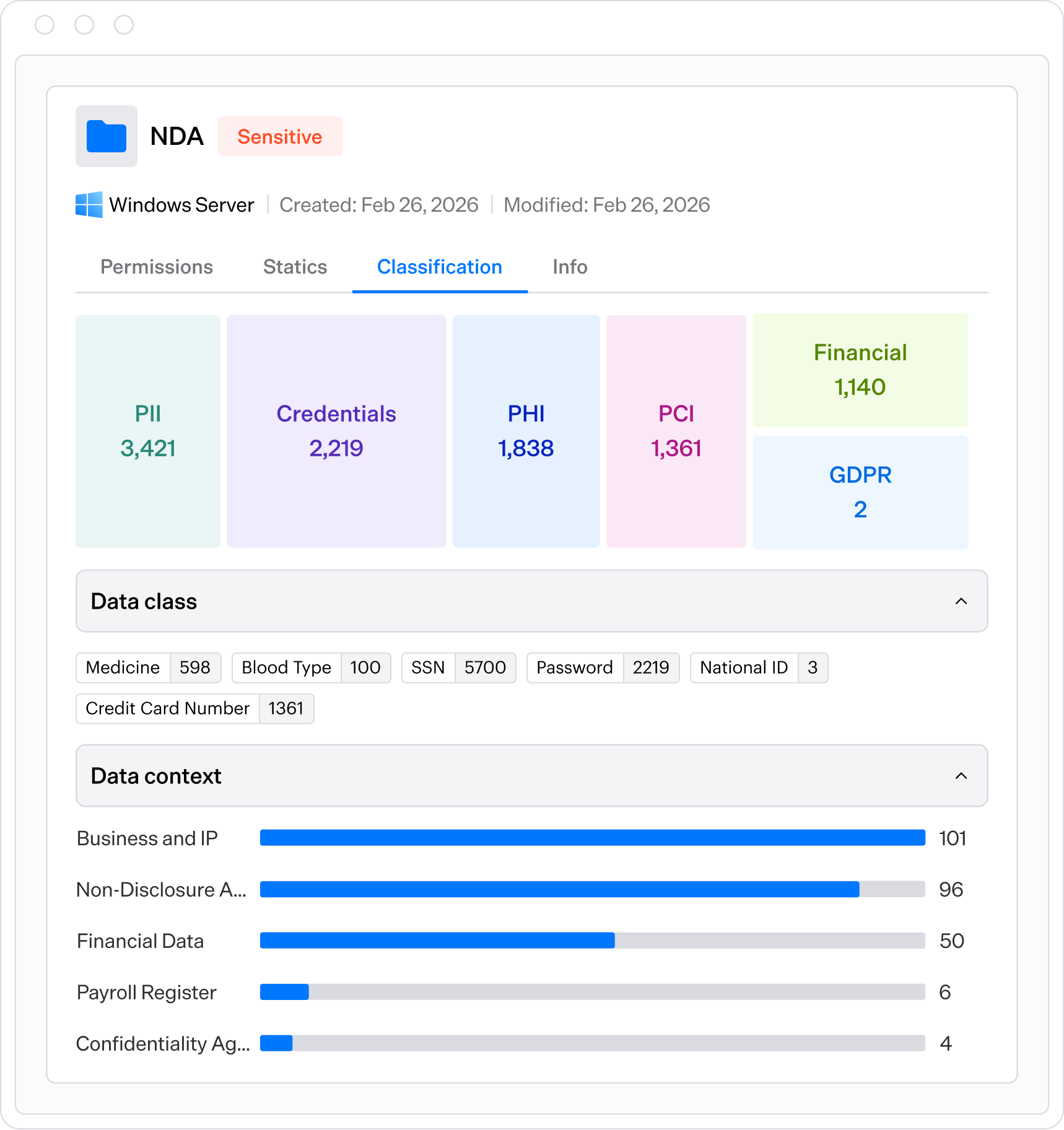
Data Class provides the foundation for identifying and categorizing sensitive content into structured types. Varonis:
- Identifies sensitive data, including PII, PHI, financial records, credentials, and regulated data.
- Pinpoints where sensitive data exists and where it may be at risk.
- Identifies exposed secrets such as API keys, tokens, and credentials hidden within unstructured content, where regex-based detection has historically struggled.
Example: A finance team stores a spreadsheet of vendor payment details alongside routine budget files. Data Class identifies the bank account and routing numbers within it as financial data, flagging the file as sensitive even though it lives in a folder with dozens of otherwise low-risk documents.
2. Data Subject
Two files can carry the same sensitivity label and still represent very different levels of risk, depending on whose data it is. By classifying the data subject, Varonis:
- Identifies business function, ownership, and operational criticality.
- Distinguishes sensitive-but-low-impact from sensitive-and-business-critical.
- Includes higher-confidence person-name entity detection, sharpening precision for privacy, compliance, and investigation use cases.
Example: An insider leaving the company downloads files. Data subject adds context specifying that the sensitive files are customer contracts and product roadmap data.
3. Data Topic
A keyword can't tell you what a document is actually about. Treating every instance of a term or pattern as equally sensitive creates noise instead of insight. With Data Topics, Varonis:
- Defines subject matter and intent, including whether it pertains to M&A, payroll, source code, customer contracts, and other domain-specific themes.
- Learns language and topics unique to each customer's own environment, without manual tuning.
- Can flag a file as sensitive from meaning alone — no keyword or format match required.
- Calibrates sensitivity to each organization's own industry, geography, and business activity.
Example: The word "sodium" could relate to fertilizer ingredients or a medical patient record. Without evaluating surrounding content, there's no way to know which — and if it's the latter, that implicates PHI/HIPAA and SSNs.
4. Classification Enrichment
As we’ve discussed, data classifications without greater context limit results to insights rather than delivering outcomes. Grounding your sensitive data in its relationship to your business and security operations enables more actionable intelligence and answers the question, “Why should I care about this right now?”
By enriching classifications, Varonis:
- Augments findings with access, activity, and risk signals.
- Correlates sensitivity to exposure level, usage patterns, and policy violations.
- Continuously updates enrichments as data, access, and usage evolve.
Example: Two files are classified as sensitive Business and IP data related to a pending acquisition. Both contain the same information and receive the same classification result. Classification enrichment reveals that one file is locked down to a small legal team, while the other is accessible to hundreds of employees via inherited group permissions and has been downloaded multiple times recently. The classification is identical, but the risk is not.
How Varonis is different
Subject, Topic, Class, and Context signals often live across fragmented, asset-first views, making it hard to answer questions like "Where does GDPR regulated data live across my whole estate?" without piecing together multiple reports.
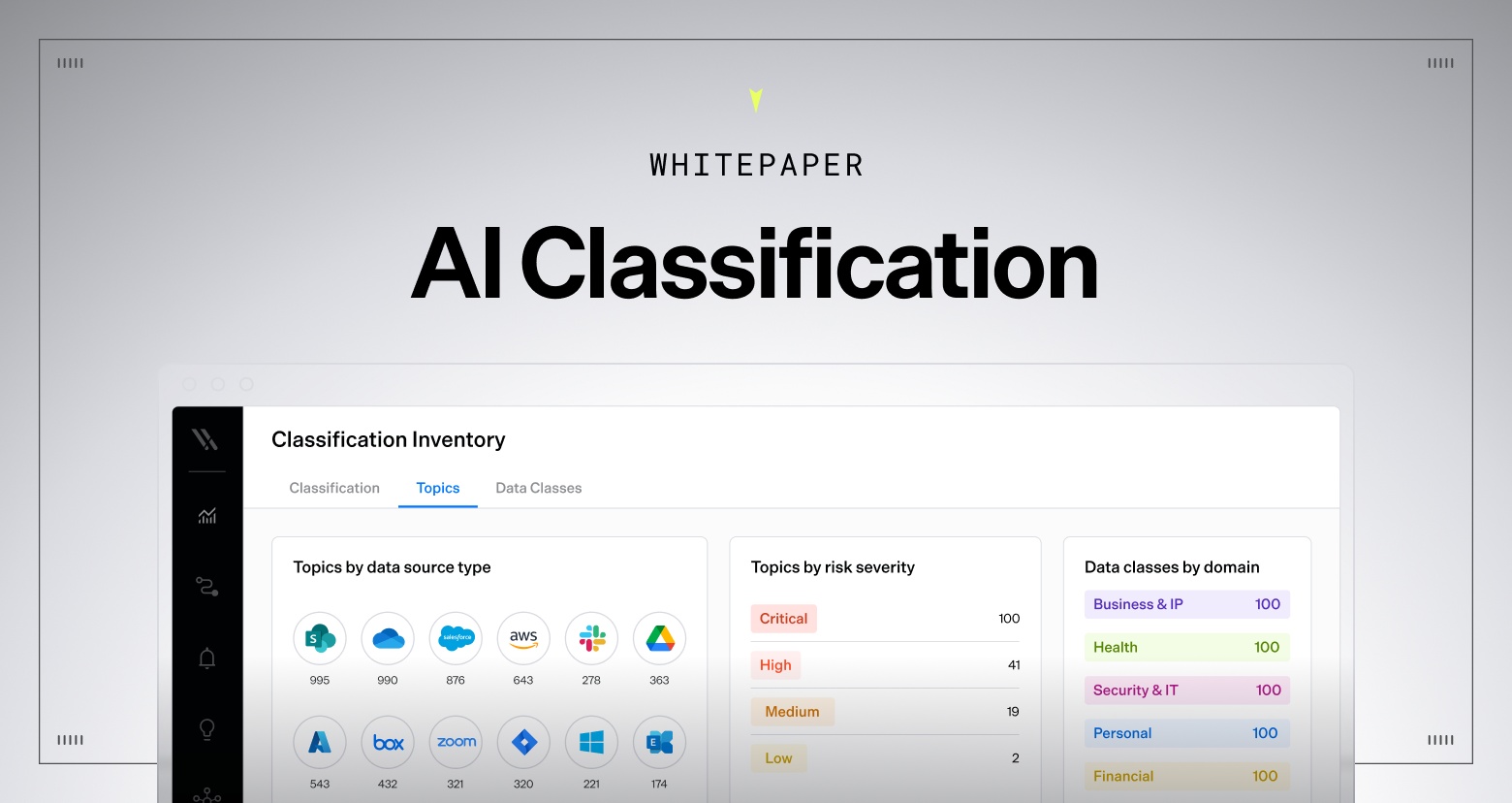
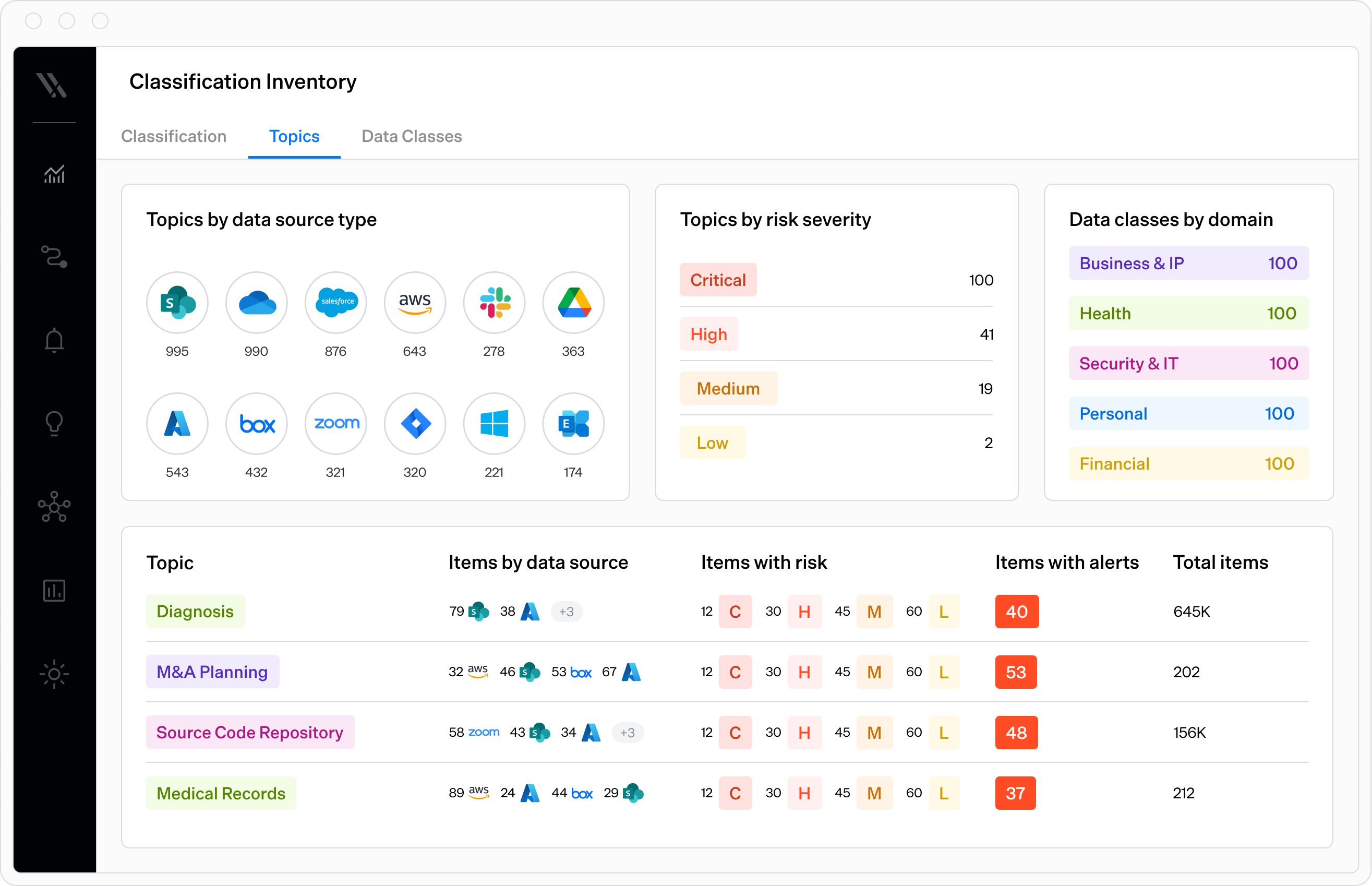
Varonis' Data Classification Inventory combines all four components — Subject, Topic, Class, and Classification Enrichment — into one data-centric view of what data is, why it matters, who can access it, and how it's used. Teams can start with why the data matters or data class, then drill straight into the affected assets.
Where data discovery or DSPM tools often stop at a label, Varonis uses classification to drive threat detection, exposure analysis, and automated remediation across the entire data estate.
Making AI data classification explainable
Using AI to classify data is only useful if you can trust it, and trust requires explainability and the ability to verify results.
Many tools can use AI to read and classify content but don’t offer a way to verify its accuracy or the reasoning behind it. If you can't understand why data was classified a certain way, you can't confidently act on it. Explainability turns AI-powered data classification from a black box into intelligence that can be verified, trusted, and operationalized across governance, threat detection, and remediation workflows.
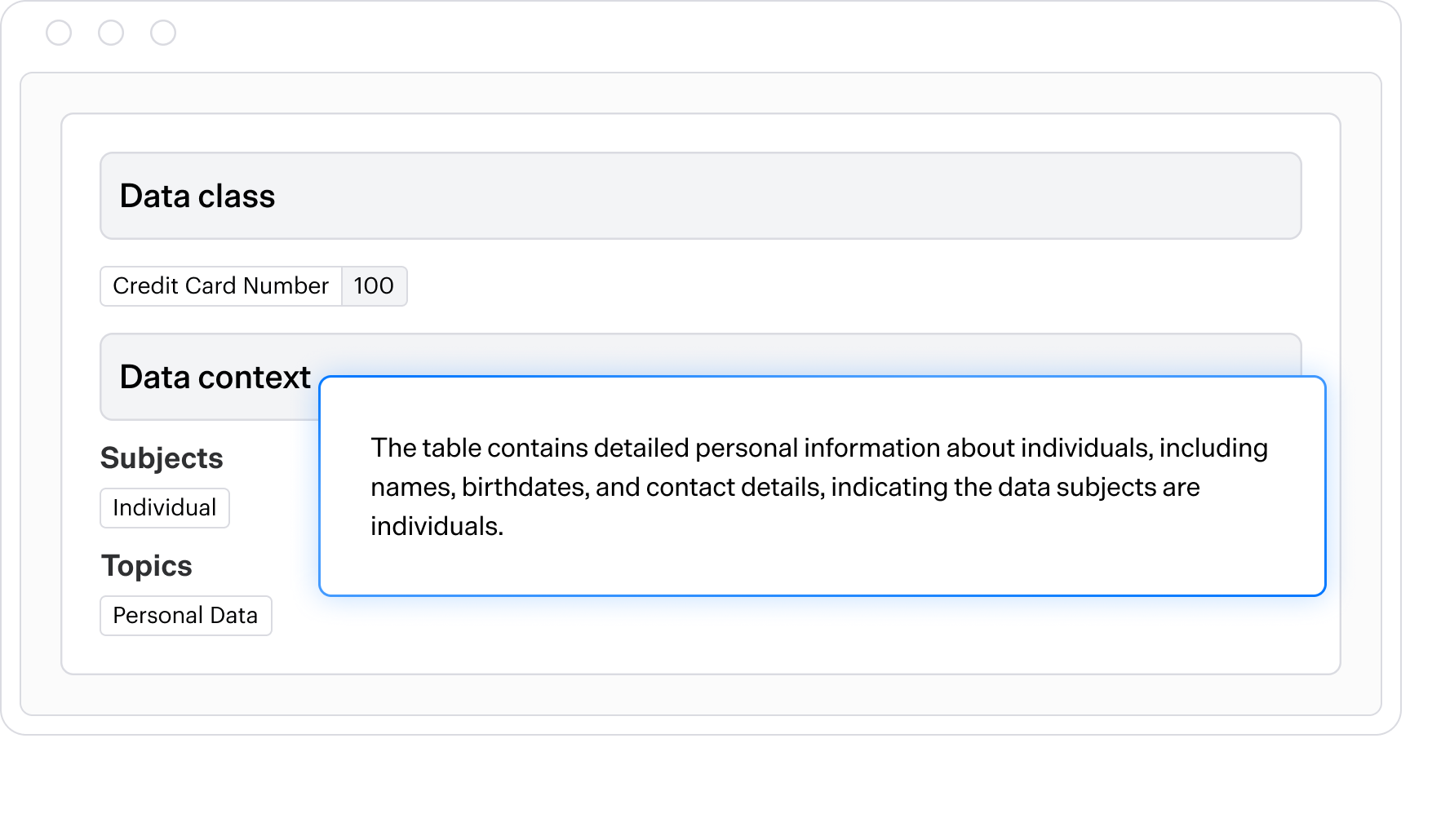
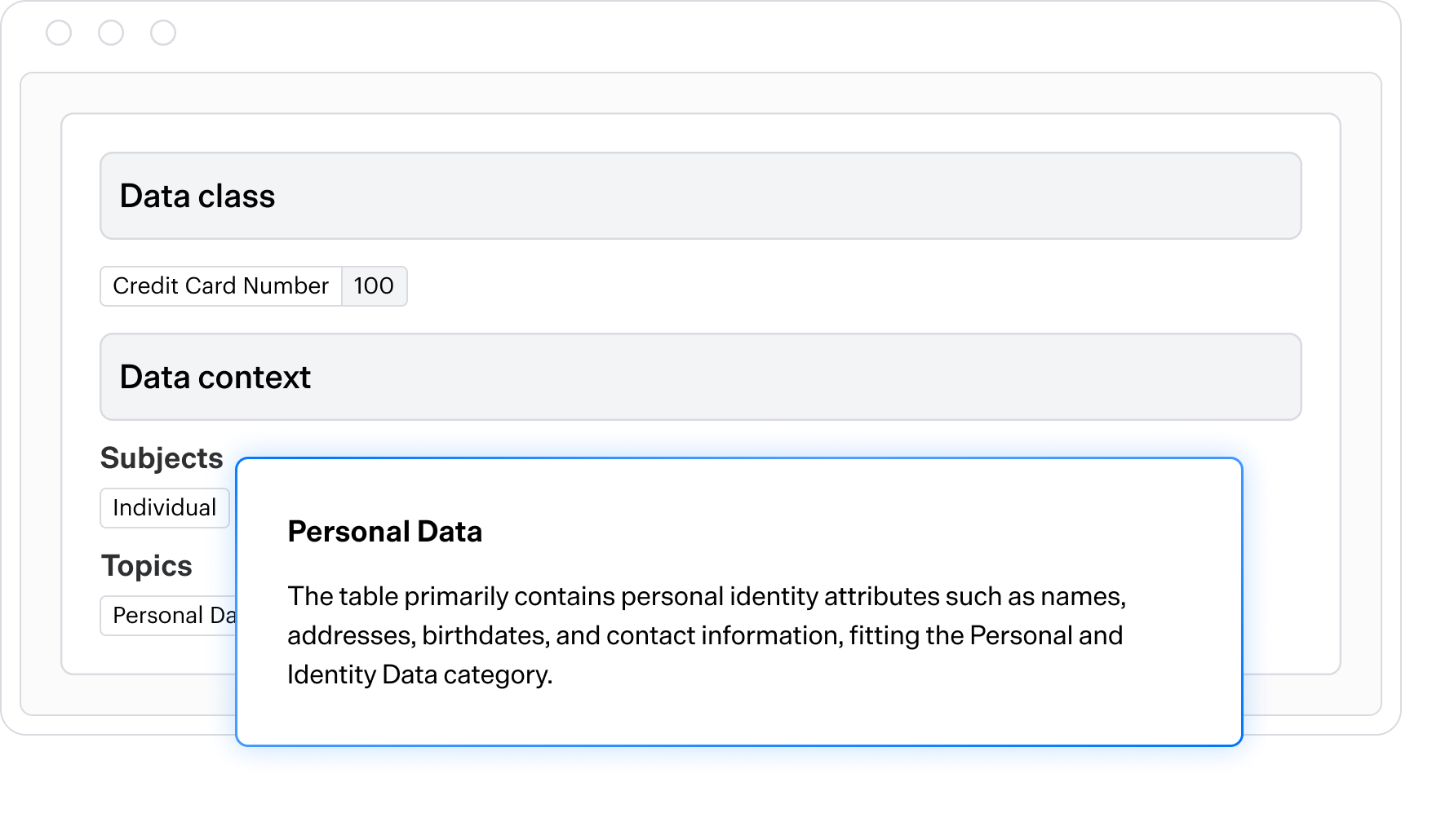
Varonis provides transparent, human-readable reasoning behind every AI classification, so you know exactly where it came from. This includes:
- What was detected: Patterns, entities, topics, with specific text highlighted and underlined in context.
- How it was determined: AI inference, deterministic match, or both, with human-readable descriptions explaining the rationale.
- Why it matters: Exposure, access, business criticality.
Every result is auditable for compliance, defensible under scrutiny, and verifiable.
Going back to the sodium example: without explainability, a user may see a classification result on the term "sodium" but have no way to determine whether it relates to agricultural fertilizer data or a patient’s medical record. Varonis surfaces the exact source text and surrounding context that drove the result, allowing users to quickly validate whether the classification is tied to a healthcare record or another use of the term entirely.
Varonis believes in building a classification engine that is accurate from the start, which is why we invest in extraction and OCR quality, ensuring that even inconsistent or hard-to-parse files are read reliably.
How to turn data classification into security outcomes
Once you’ve established a complete, current, and contextualized AI Classification engine that you can trust, the final piece is turning that visibility into outcomes. For most solutions, classification is the endpoint. For Varonis, it's the starting point.
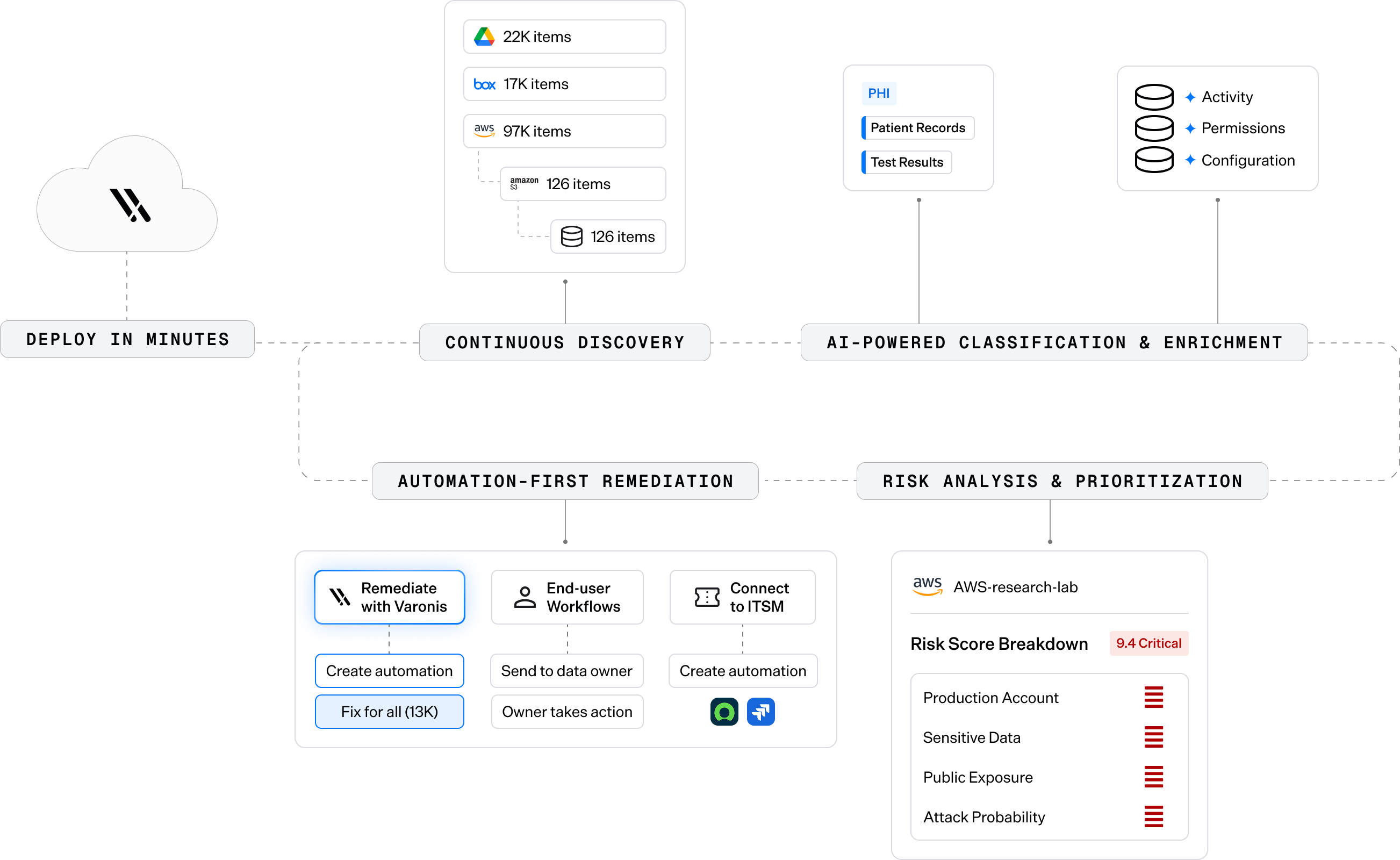
Varonis turns classification into outcomes by integrating classification intelligence directly into:
- Risk prioritization: Sensitivity + exposure + activity = determines real risk.
- Automated remediation: Fix overexposed data, revoke unnecessary access, and enforce least privilege, with enough historical context to verify it won’t break a business process.
- Threat detection: Behavioral analytics on classified data surfaces real threats.
- Governance workflows: Policy enforcement, access reviews, retention management.
Let’s see what that looks like in practice. A due diligence file for an unannounced acquisition sits in a shared drive. Varonis AI Classification identifies it as sensitive Business and IP data based on its content. Varonis flags it as overexposed to an organization-wide group. Later on, it detects a user account accessing the file from a location it has never logged in from before. Because Varonis correlates all these signals together, the activity is immediately prioritized as high risk. This enables investigation and response through either automation, guided remediation, or Varonis MDDR.
It might take three separate tools to identify sensitive data, discover that it's overexposed, and monitor for access from an unusual geolocation. Varonis does all three, correlates the intelligence together, and takes automated action to reduce risk. Without all these ingredients woven together, you're getting fragments of intelligence, not the bigger picture and actionable risk reduction.
Data residency and privacy
Varonis provides full transparency into its AI classification models while preserving data residency.
When AI analysis is needed to understand a file's meaning, only a sample of its content is sent to the Varonis cloud environment. That sample is encrypted in transit and processed solely to generate a classification result. That sample is not stored, and once a file has been classified, it isn't reprocessed on future scans. Customer data is never used to train Varonis AI models.
In cases where organizations have regulatory constraints that require their data to remain within their perimeter, Varonis offers local deployment, with models run in the customer's environment. Rather than treating customer content as training material, Varonis uses it to generate classifications, metadata, and security insights that remain under the customer's control.
This architecture offers both a fast time-to-value for the default managed model and an option for privacy-sensitive use cases.
Varonis AI Classification: using context to drive outcomes
Accurately discovering and understanding sensitive data is important. It’s the foundation. But reading data well was never the hard part. The catalyst in turning classification intelligence into security outcomes is context: knowing who has access, whether data is overexposed, why the data matters to the business, and whether action can be taken automatically and safely. With context and explainability, data classification can deliver real outcomes: a reduced blast radius and threat prevention. Varonis AI Classification is best-of-breed and goes beyond intelligence to deliver accurate, explainable, and actionable results at scale.
That’s the outcome Varonis AI Classification is built to deliver.