In today's data-driven world, proper data governance is critical to ensure compliance with privacy regulations, avoid penalties, and protect your organization's reputation.
But sensitive data often ends up where it shouldn’t or stays beyond its required retention period, posing privacy and security risks.
Data governance is more daunting than ever
Organizations are constantly confronted with massive data growth and regulatory demands. Today’s environments make even basic governance tasks difficult to execute reliably and consistently. Factors like…
- Sheer data volume. Petabytes of data spread across multiple systems make it difficult to create, manage, and enforce governance policies.
- Complex regulatory requirements. Strict and evolving privacy regulations require constant monitoring to ensure sensitive data is handled and retained correctly.
- Obsolete and stale data. Identifying and removing outdated information is labor-intensive yet essential to reduce unnecessary risk and storage costs.
- Cloud and domain migrations. Large-scale migrations require separating essential data from non-essential files without breaking access or disrupting business operations.
- Inconsistent data placement. Sensitive data frequently ends up in the wrong locations, increasing the chances of exposure or compliance violations.
These challenges highlight the need for a more automated and reliable approach. Enforcing governance at scale requires a reduction in manual management
Data lifecycle automation takes governance off your shoulders
Data Lifecycle Automation eliminates the need for manual data management, clean-up, and removal. Lifecycle automation tools automatically apply governance rules, move data as conditions change, and ensure that sensitive information is stored appropriately throughout its lifespan.
Automating these tasks reduces the need for custom scripts or ongoing human intervention. It also helps organizations maintain consistent data hygiene, support compliance requirements, and prepare for broader initiatives such as cloud migrations or storage optimization.
How lifecycle automation streamlines data governance
Automatic policy enforcement
Lifecycle automation tools allow you to create and automatically enforce unique lifecycle, retention, and residency requirements tailored to different departments, servers, data types, and sensitivity levels. They continuously monitor your environment to identify instances where data governance practices violate company policies, such as retaining personally identifiable information (PII) beyond its permitted timeframe.
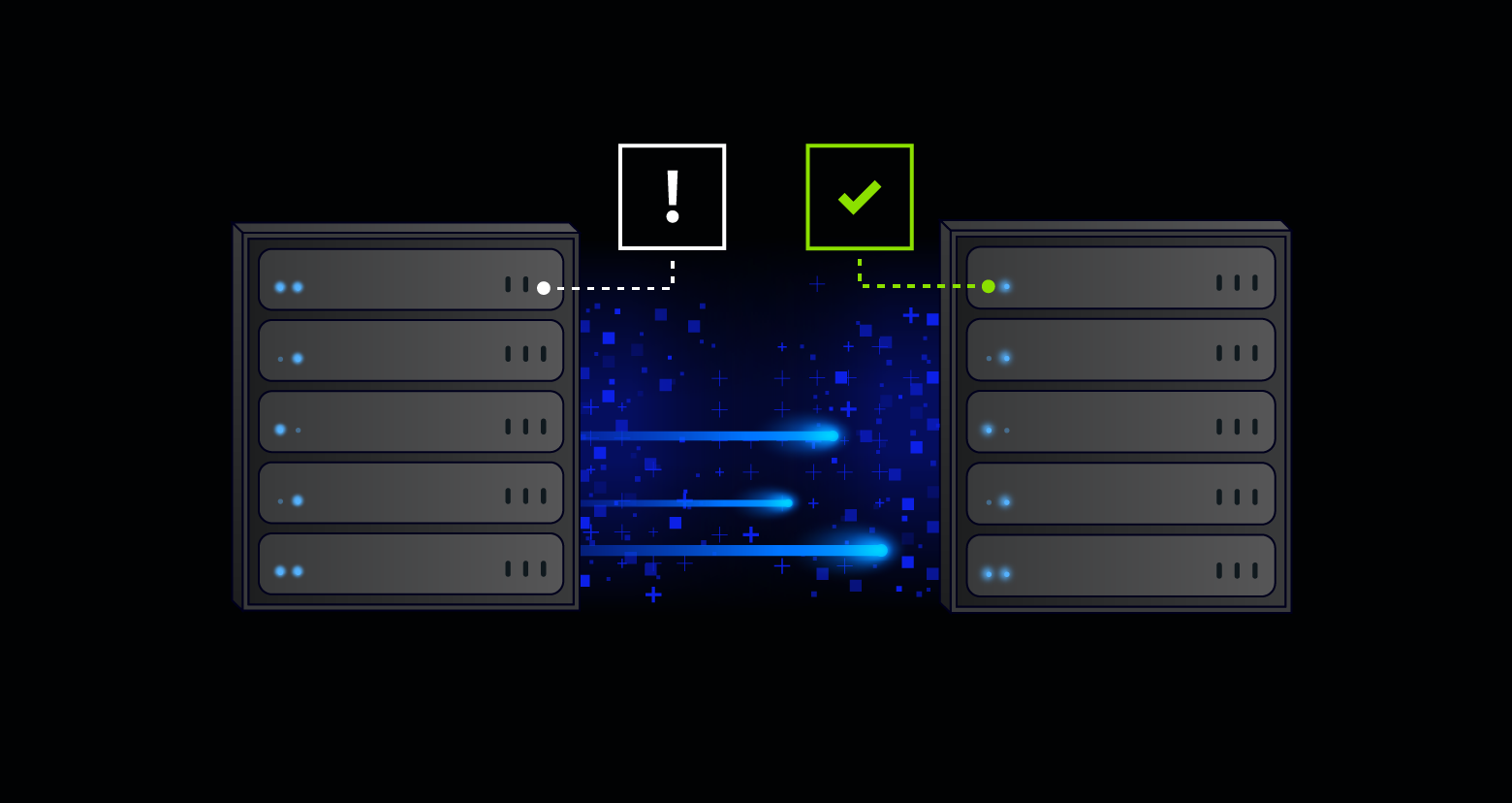
Data lifecycle automation addresses these compliance issues by relocating the non-compliant data to a secure location. Once the data is moved, admins can take further actions on the data, such as review, archival, or deletion, to ensure compliance and protect sensitive information.
These policies are also designed to mitigate the impact of a data breach and ensure that sensitive information does not end up in risky, non-compliant locations or become accessible to AI systems. Data is consistently monitored. Quarantine protocols are immediately upon detecting any policy violations, such as GDPR data being exposed to the entire organization.
Support large-scale domain consolidation and cloud migrations.
Develop policies to easily consolidate domains and handle large-scale data migrations, all while ensuring data stays protected and permissions are optimized. Stage on-premises data for cloud migrations with powerful rules that can separate the files you need from those you don’t.
Seamlessly copy or move large amounts of data cross-domain or cross-platform without the risk of breaking permissions or interrupting business. Take full control of naming conventions, permission structures, and collision behavior to ensure consistency as data moves across the environment.
For instance, if your organization is transitioning part of its operations from Windows file servers to a new NAS device, you can establish a policy targeting specific folders for migration. This policy will automatically move the selected folders from the file server to the NAS device while preserving the original file and permission structures.
Optimize storage and reduce costs.
Another significant challenge organizations face is efficiently managing storage and eliminating obsolete data without disrupting operations. Organizations must balance retaining information for compliance with streamlining storage.
Data lifecycle automation helps by implementing robust storage optimization strategies. By monitoring data activity, it identifies stale files and automatically transfers them to a secure location for archival or deletion, optimizing storage and reducing costs.
Varonis creates granular policies for specific retention requirements, ensuring non-essential data is removed. Policies based on creation date, last access date, or data sensitivity help maintain an efficient storage environment.
How Varonis Data Lifecycle Automation worksOur approach to data lifecycle automation builds on a foundation of automated classification, labeling, permission remediation, exposure reduction, configuration fixes, and data masking.
Creating and enforcing data governance policies has never been easier than with Varonis Data Lifecycle Automation. You can easily create custom, no-code policies that will automatically and seamlessly copy or move data across your environment from one location to another.
Varonis Data Lifecycle Automation is just one part of the comprehensive Varonis Data Security Platform (DSP). By combining Data Lifecycle Automation with Varonis' industry-leading data discovery and classification, automated risk reduction, and threat detection capabilities, you can ensure sensitive data is identified, secured, and compliant throughout its lifecycle from a single, unified platform with little to no manual effort.
Configuring granular policies
You can configure granular policies based on a multitude of attributes, such as source location, sensitivity, regulation, exposure, activity, creation date, and more. This enables you to easily create custom policies to fulfill your unique data governance, lifecycle, and compliance needs. As you configure your policy, you can also preview the data that will be affected before you apply it.
Configure the Varonis Data Lifecycle Automation Policy to fit your needs.
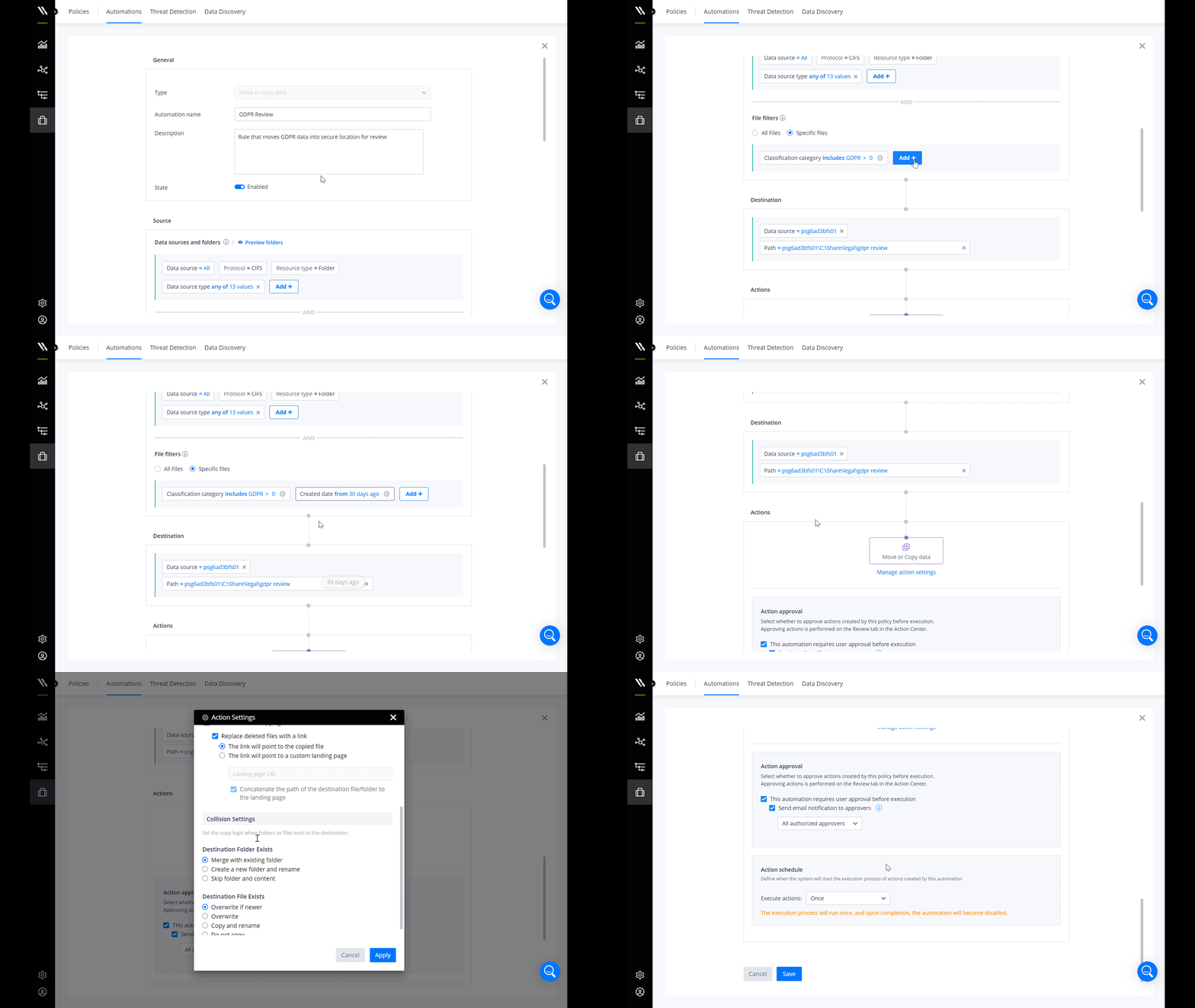
Configure the Varonis Data Lifecycle Automation Policy to fit your needs.
As a part of the policy creation, you can set whether you want to maintain the file structure and permissions in the new location, ensuring that users can continue to access and use the data in the new location if necessary.
Determine if the folder structure and system permissions should be copied with the data.
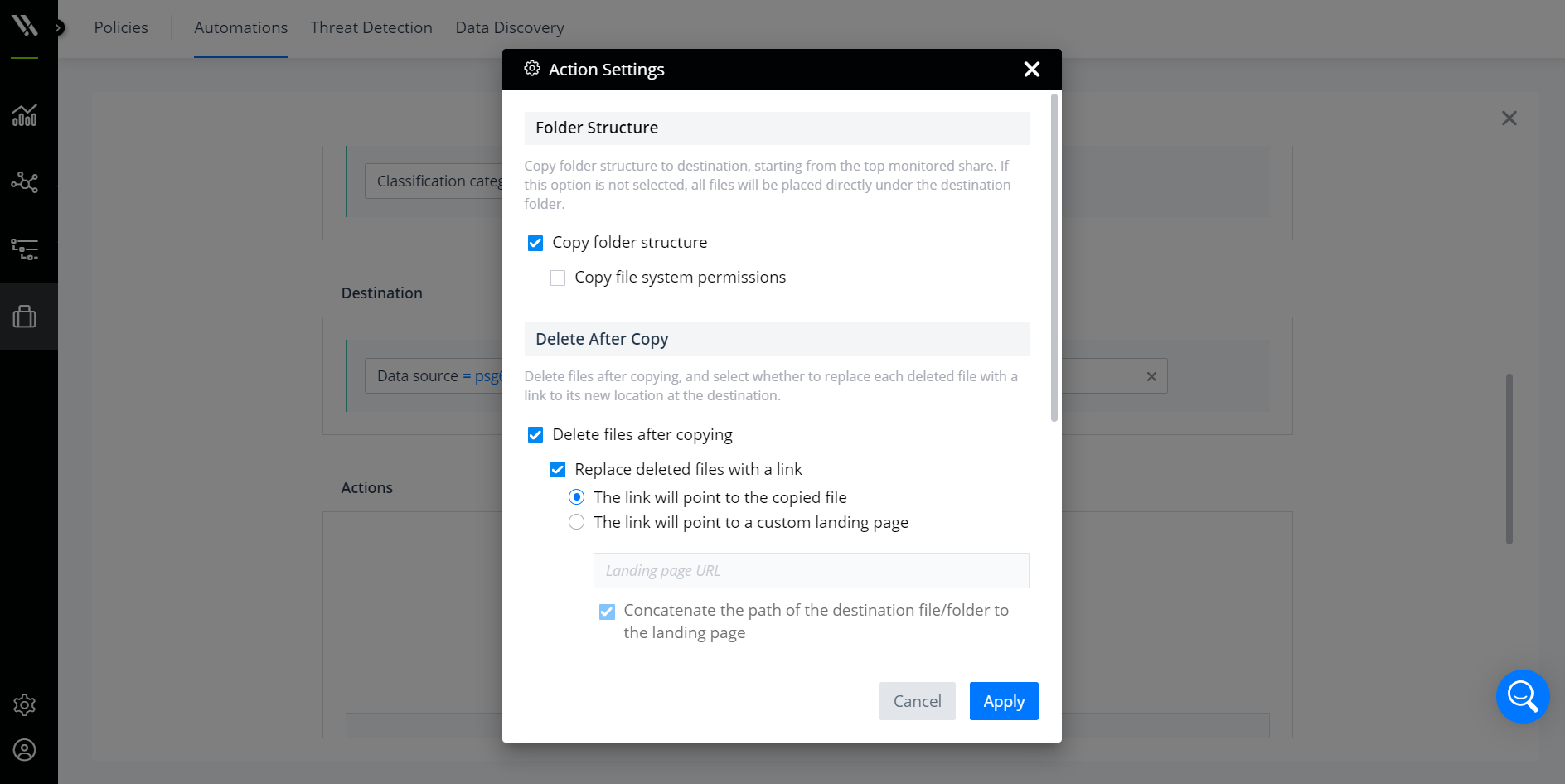
Determine if the folder structure and system permissions should be copied with the data.
Additionally, you can set the collision behavior and specify the copy logic for situations where folders and files already exist in the destination. Options include overwriting the existing data, merging the data, skipping the data, or renaming the new data.
Configure the policy’s collision behavior.
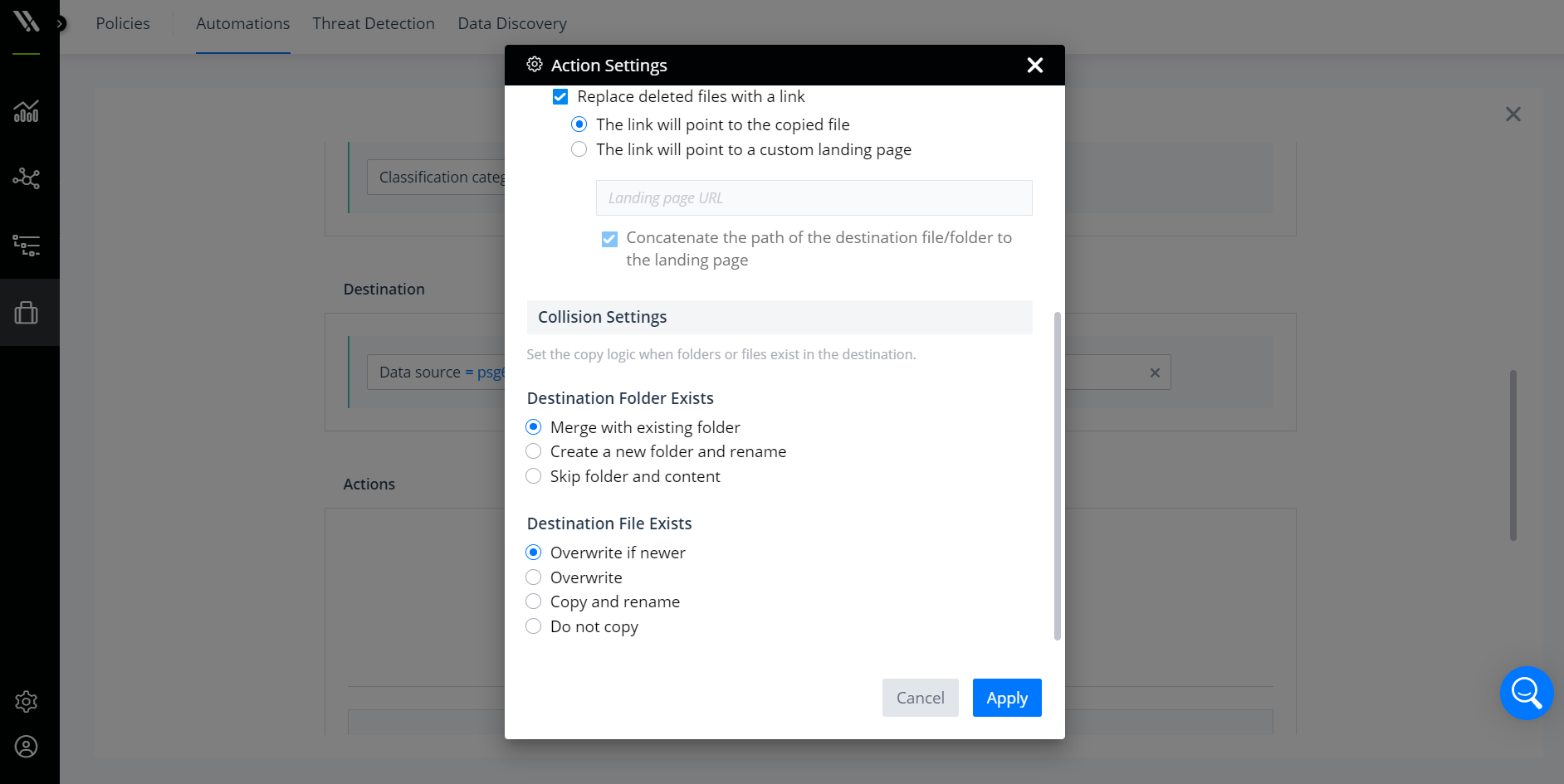
Configure the policy’s collision behavior.
Scheduling and approving policies
You can configure policies to run once, daily, weekly, monthly, or continuously. If set to run continuously, Varonis will automatically execute the policy once it identifies data that falls within the policy’s parameters.
Varonis includes human-in-the-loop controls to verify that policies function correctly by requiring authorization before execution. When configured, Varonis notifies the appropriate authorizers for approval prior to running the action.
Configure authorizers and the action schedule.
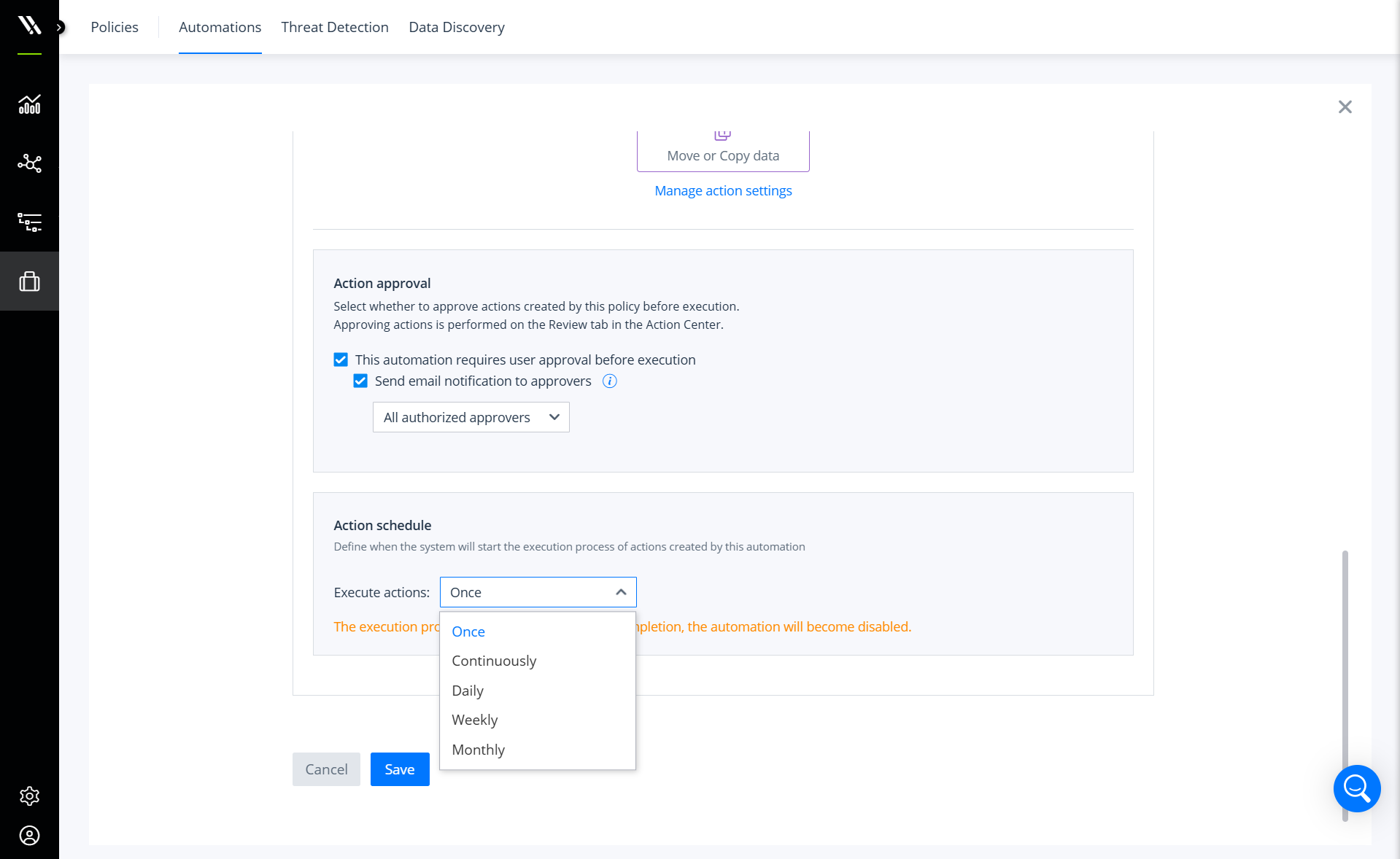
Configure authorizers and the action schedule.
Executing the policy
Once the policy is created, Varonis continuously monitors your environment to detect data that falls within the policy’s set parameters. Varonis Data Lifecycle Automation then automatically copies or moves the target data to a specified secure location, ensuring your data governance practices consistently comply with relevant business and regulatory requirements.
After the data is moved, Varonis creates a stub file in the original location that explains why the data was relocated and provides a link to the new location or a designated landing page.
From there, admins can take further action on the data if necessary, such as reviewing, deleting, or archiving the data.
Try Varonis for free.
Knowing where your sensitive data exists, who can access it, and what users are doing with it are all critical questions that need answers to ensure compliance and protect it from cyberattacks. Varonis uniquely combines these key security aspects in one unified solution.
At Varonis, we’re on a mission to deliver automated security outcomes with a holistic approach to data security. Our unified Data Security Platform installs in just minutes and protects your sensitive data wherever it resides, including cloud, SaaS, and data center.
Are you curious to see what risks may exist in your environment and achieve tangible security outcomes with minimal effort? Schedule a demo to get started today.
FAQs about data lifecycle automation
What is data lifecycle automation?
Data lifecycle automation is the process of removing manual tasks from data management, from creation to archival and eventual deletion. It involves enforcing pre-defined policies to automatically move, copy, or quarantine data based on rules related to its age, sensitivity, or regulatory requirements. The result is more comprehensive governance and less manual effort.
How does data lifecycle automation support cloud migrations?
Data lifecycle automation streamlines cloud migrations by automatically identifying and segregating essential files from obsolete data before the move. Policies can be set to stage on-premises data, ensuring only necessary information is transferred while preserving its original permissions and structure. This minimizes migration complexity, reduces costs, and prevents business interruptions.
How does automating the data lifecycle improve security?
Automating the data lifecycle improves security by systematically reducing the data attack surface and minimizing risk. It automatically enforces policies that quarantine overexposed or misplaced sensitive data, moving it to a secure location to prevent unauthorized access. By also managing data retention, automation ensures stale sensitive information is properly archived or deleted, limiting the potential impact of a data breach.
What kinds of data policies can be automated?
Data lifecycle automation allows for the creation of granular, no-code policies based on numerous attributes to meet unique business and compliance needs. You can set rules based on criteria such as data sensitivity, specific regulations like GDPR, exposure levels, user activity, creation date, and last access date. This flexibility enables organizations to apply precise data governance controls across their entire environment.