.png)
Look, here's what we see all the time: enterprise security teams are buried under dozens of tools, each one screaming about something different, and none of them talking to each other. Your email security catches something fishy. DSPM flags exposed data. Identity systems notice a suspicious login. But they're all operating in their own little worlds.
So what happens? You're playing detective, manually connecting dots between systems. By the time you've figured out how the pieces fit together, either the damage is done or you've just wasted three hours chasing a false alarm.
Varonis works differently.
We built our platform as a unified security data fabric from the ground up, not a bunch of products duct-taped together. Everything flows into a central intelligence layer we call the Varonis Data Fabric (aka Unified Data Security Platform). It normalizes and enriches data across domains, correlates signals, and adds context — work that most platforms skip or do poorly. That normalized, aggregated data becomes a foundation AI can actually learn from and act on. The Varonis Data Fabric doesn't just store intelligence; it makes decisions and takes action automatically.
The flow is straightforward:
- Data streams in from everywhere — identity, data access, email, AI interactions, databases, SaaS applications, endpoints
- A unified data fabric that ingests and enriches it with behavioral context and classification metadata, then correlates it across all those domains
- An AI layer that makes decisions in real time — blocking risky actions, escalating high-confidence threats, and enforcing least privilege dynamically
Here's why this matters: one event in one domain can cascade through everything else. Let's say email security catches an anomalous email. It doesn't just generate an alert and call it a day. It increases that user's risk score, which can trigger stricter downstream DLP enforcement, correlate activity against sensitive prompts to LLMs, or escalate the case to your Varonis Managed Data Detection and Response (MDDR) analyst for investigation.
This is the shift that happens when you move from point solutions to a unified fabric. You're not just collecting more data, you're turning scattered signals into coordinated, high-fidelity security outcomes at scale.
What data Varonis is actually ingesting
The Varonis platform pulls telemetry from four core security domains: identity, data access, email, and AI interactions. From there, coverage extends into database activity monitoring (DAM), privacy and compliance systems, threat detection, and more, but those four pillars are where most of the signal originates.
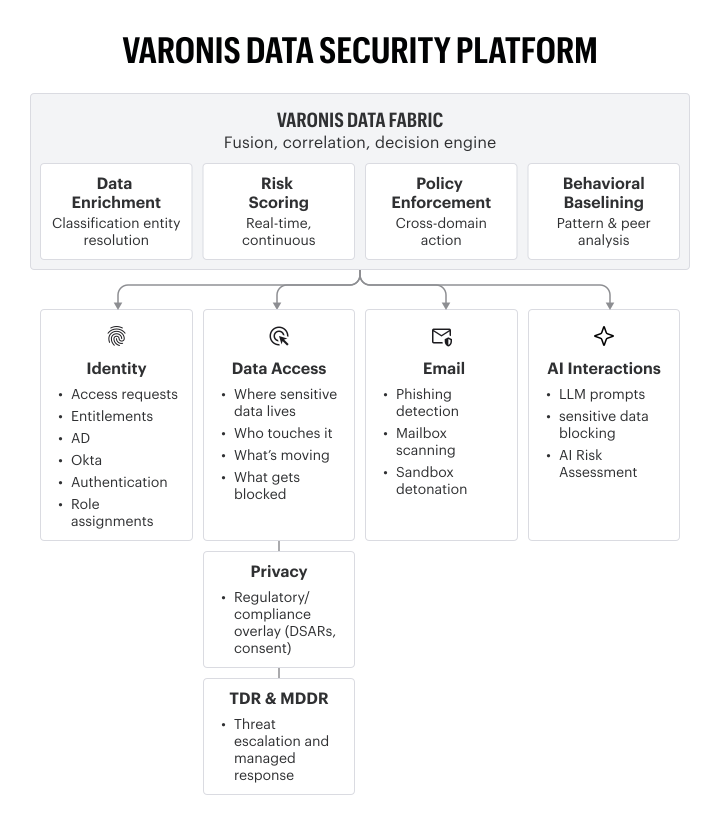
That's a lot of telemetry. And the scale is real, we're talking multi-petabyte environments with hundreds of millions of audit events per day. You're not just connecting a few systems. You're ingesting metadata from proprietary databases, legacy file servers, distributed SaaS environments, and everything in between.
This creates two challenges: getting the data reliably, and getting it fast enough to actually act on.
We solve this with a distributed collector architecture. Collectors sit close to data sources —on-prem, in cloud regions, wherever the data lives — and stream metadata back to the Varonis Data Fabric in real time. If a collector goes offline, the others keep running. If you're a multinational with infrastructure in twelve countries, you deploy collectors regionally, and they handle the ingestion workload locally before sending enriched signals upstream.
We also support custom connectors for proprietary systems. If you've built your own application or run a niche database, Varonis can pull metadata from it because incomplete visibility defeats the whole purpose of a unified fabric.
And here's the critical part: this is incremental scanning, not full rescans. The system tracks what it's already seen and only processes what's new. That's how it handles petabyte-scale environments without grinding to a halt.
How Varonis actually scales
Let me be really specific about scale, because this is where a lot of platforms completely fall apart.
Varonis is proven in environments with:
- Multiple petabytes of data under management
- Hundreds of millions of audit events ingested daily
- Distributed deployments across global regions
- True incremental scanning that doesn't require full rescans every time something changes
This is what the Varonis platform does in production right now for some of the largest enterprises in the world. The architecture that makes this possible is built on a few core principles:
-
Distributed collectors handle ingestion and initial processing close to the source. You don't bottleneck everything through a single pipeline. If one region's infrastructure is slow, it doesn't slow down the others.
-
Incremental metadata tracking means the system knows what it's already classified, what permissions it's already evaluated, and what behaviors it's already baselined. It only processes deltas, which keeps performance stable even as data grows.
-
Horizontal scaling across compute and storage layers. As your environment grows, you add capacity without rearchitecting everything.
This isn't just infrastructure for the sake of infrastructure. It's the foundation that lets the Varonis Data Fabric operate in real time. If your telemetry pipeline is slow or unreliable, none of the intelligence layer matters — you're always reacting late. We built for speed and resilience first, then layered the intelligence on top.
How Varonis enriches raw data
Raw telemetry is just noise until you add context. An audit log that says "User accessed File X" doesn't tell you anything useful. You need to know: Is File X sensitive? Has this user accessed it before? Is this access pattern normal for their role? Are they about to leave the company? Are they already flagged as high-risk for other reasons?
This is what the Varonis Data Fabric does. It takes metadata from every domain and enriches it into something you can actually act on.
Here's what enrichment looks like in practice:
-
Contextual classification: The system automatically classifies data based on content — PII, PHI, PCI, trade secrets, source code. It doesn't rely on users tagging files correctly. It scans at rest and in motion, labels what it finds, and tracks sensitivity over time.
-
Entity resolution: It maps identities across systems. Your AD account, your Okta profile, your HR record, your email address — these all get unified into a single entity so the platform knows it's the same person even if different systems call you different things.
-
Behavioral baselining: Machine learning models build profiles of normal behavior for every user, device, and data resource. How often does this person access the finance share? What time of day? From what location? What do their peers do? Deviations from baseline get flagged automatically.
-
Real-time risk scoring: Every entity — user, file, folder, database, application — gets a dynamic risk score that updates continuously based on behavior, access patterns, exposure, and external signals. A user's risk score can spike in seconds if they do something anomalous.
-
Threat intelligence integration: The platform pulls in external feeds, known malicious IPs, phishing domains, and indicators of compromise. If a user performs risky behavior, that signal feeds into their risk score and the alerting layer.
The goal here is precision. You're converting high-volume, low-fidelity telemetry into low-volume, high-fidelity intelligence. The Varonis Data Fabric filters out the noise and surfaces what actually matters. When an alert fires, it's worth investigating.
How the Varonis Data Fabric makes decisions
Enrichment gives you context, but context alone doesn't stop threats. You need decision logic that automatically acts on it.
The Varonis Data Fabric uses a correlation engine that maps every user to the data they touch, the sensitivity of that data, their role and entitlements, and their behavioral baseline. When an event occurs, the engine doesn't evaluate it in isolation. It scores the deviation against the full context graph: How sensitive is this data? How unusual is this access? What else has this user done recently? What's their current risk score?
That scoring drives policy enforcement. You define rules once: "block high-risk users from downloading PII," "require approval for access to M&A documents," "escalate when anomalous behavior hits sensitive data," and the Varonis Data Fabric enforces those rules across every connected domain. The decision cascades automatically because all enforcement points share the same intelligence layer.
This is what turns scattered signals into coordinated action. Varonis isn't just watching, it's deciding and acting in real time.
How cross-domain correlation actually works
This is where the fabric model creates real leverage. You're not just enriching data, you're correlating it across domains in real time and using that correlation to drive automated decisions.
Here's the bidirectional flow:
-
Domains → Varonis Data Fabric: Each domain has its own AI agents that send metadata upstream. Email security sends phishing signals. Identity protection sends login anomalies. DLP sends data movement events. These agents are purpose-built for their domain, but they all speak the same language when they talk to the Varonis Data Fabric.
-
Varonis Data Fabric → Domains: The Varonis Data Fabric processes everything, correlates it, and sends enriched context back down. A phishing email doesn't just trigger an email alert — it raises the user's risk score globally, which propagates to DLP, AI Security, DSPM, and TDR. Those systems can now make smarter decisions because they know what the email layer knows.
Automated decision logic sits on top of this. You define policies once: "If a high-risk user tries to download PII, stop it," and the platform enforces that policy across every domain where it's relevant. The user can't email the file, upload it to a personal cloud drive, paste it into an LLM prompt, or query it from a database. The decision cascades automatically because all those enforcement points are connected to the same intelligence layer.
Let me give you concrete examples of what this looks like today.
Example 1: Sensitive data upload to LLM
A sales rep downloads a spreadsheet containing customer PII from the finance share such as names, email addresses,and account numbers. Ten minutes later, they open ChatGPT and paste a chunk of that data into a prompt asking the LLM to draft personalized outreach emails.
Here's what happens:
- DLP sees the file download and tags it as containing PII based on content classification
- AI Security detects the sensitive content in the LLM prompt and blocks it before submission
- DSPM shows that the user has read access to the finance share but rarely accesses it—this is outside their normal pattern
- Varonis Data Fabric correlates these signals: recent download of PII + attempted upload to unapproved LLM + unusual data access = high-risk behavior
- The incident gets logged with full context: what file was accessed, what data it contained, where the user tried to send it, and whether this fits their role
- TDR surfaces this as a policy violation with enough context that the security team can decide whether it's malicious, negligent, or just needs user education
The force multiplier here: without the fabric, you'd have three separate alerts from three tools with no connection between them. DLP sees a download. AI Security sees a blocked prompt. DSPM sees unusual access. You'd have to manually figure out it's the same incident and by then, the user might have found another way to exfiltrate the data.
Example 2: Cross-domain least privilege enforcement
This one's less dramatic, but happens constantly. A contractor brought in for a three-month project has access to the engineering share. The project ends. The contractor stays on for other work. Six months later, they still have access to the engineering data they haven't touched in half a year.
Here's what the fabric does:
- DSPM tracks access patterns and sees the user hasn't accessed the engineering share in 180 days
- IGA shows the contractor's role changed four months ago and no longer requires engineering access
- Varonis Data Fabric correlates: stale permissions + role change + no usage = over-entitled access
- The platform flags this as a least-privilege violation and generates a remediation workflow
- The contractor's manager gets a notification: "This user has access to sensitive data they no longer need. Approve removal or justify retention."
- If the manager doesn't respond in 7 days, access gets revoked automatically
Multiply this by 10,000 users, and you've got continuous, automated least-privilege enforcement driven by actual behavior — not guesswork or manual quarterly reviews.
This is the difference. Each domain is good at its job, but none of them would catch these patterns on their own with enough confidence to act. The correlation across identity, data access, and behavior is what turns scattered signals into definite action.
What Varonis' Data Fabric looks like in practice
Let me show you what this actually delivers specific outcomes you get when the fabric is running:
High-confidence alerts with way less noise
Traditional SIEM and UEBA tools drown you in alerts. Most are false positives. Varonis dramatically reduces alert volume by filtering out low-confidence signals before they reach your queue. When an alert fires, it's backed by evidence from multiple domains, so you're not wasting time investigating phantom threats.
DLP policies that actually adapt
DLP policies usually break because they're too static, too strict (blocking legitimate work) or too loose (missing real threats). Varonis policies evolve based on user risk and data context. A low-risk user with a clean history can move data freely. A high-risk user, or anyone accessing unusually sensitive data, gets stricter controls automatically. You're not managing exceptions manually; the platform adjusts enforcement in real time.
Least privilege that's actually maintained
Most organizations can't maintain least privilege because they don't know who needs access to what. Varonis builds an evidence-based model of actual usage: who accesses what, how often, and for what purpose. Then it recommends removing permissions that haven't been used in 90 days, flags toxic combinations (like finance access + HR access in the same account), and automates remediation workflows. You're not guessing — you're acting on behavioral proof.
Toxic permissions get caught and fixed
Toxic permissions are combinations that shouldn't exist, like an intern with admin rights, or a contractor with access to merger documents. The platform automatically detects these by correlating entitlements with HR role data and DSPM access behavior. When it finds a toxic combo, it can either revoke access immediately or trigger an approval workflow depending on your risk tolerance.
What you actually get from Varonis
Here's the bottom line on Varonis as a security data AI fabric:
You're turning scattered telemetry from dozens of systems into coordinated, high-fidelity intelligence. You're scaling that intelligence to multi-petabyte environments without performance degradation. You're dramatically reducing alert noise because the correlation engine filters low-confidence signals before they reach your team. And you're automating enforcement across domains. So, a threat detected in email can trigger policy changes in DLP, access reviews in IGA, and escalations in TDR, all within seconds.
This isn't theoretical. It's what the platform does in production right now for some of the largest, most complex enterprises in the world — environments where manual correlation isn't just slow, it's literally impossible.
The alternative? It's what most organizations live with today: tools that don't talk to each other, analysts drowning in alerts, and response times measured in hours or days rather than seconds. You're either stitching things together with SIEM rules and hoping you didn't miss a correlation, or you're accepting that some threats will slip through because you can't move fast enough.
We built Varonis to solve that problem — not by adding another tool to the stack, but by unifying the stack under a single intelligence layer that sees everything, correlates everything, and acts everywhere.
Unified telemetry. Centralized intelligence. Coordinated action. That's the fabric.
.png)