Protecting sensitive data is a board-level imperative. Without strong data security, AI initiatives stall, innovation slows, and competitive advantages erode. AI models and agents with access to unsecured and poorly governed data create unacceptable risk, and weak data practices become a liability with regulators, prospects, and partners.
Most organizations try to protect their sensitive data by stitching together disparate tools. While always costly and inefficient, that approach was once viable when environments were simple. Now, modern attacks can't be stopped with siloed tools that only see parts of the environment. Today's threats span multiple data stores, applications, and AI tools.
In this blog, we’ll dive into Varonis’ platform advantage from improved outcomes to tool consolidation and lower TCO.
One platform for data security, AI security, and email security
The Varonis Data Security Platform provides an end-to-end approach to data security, bringing together the capabilities needed to protect data throughout its lifecycle, at rest, in use, or in motion. Gone are the days of point solutions and fragmented products that address structured and unstructured data separately.
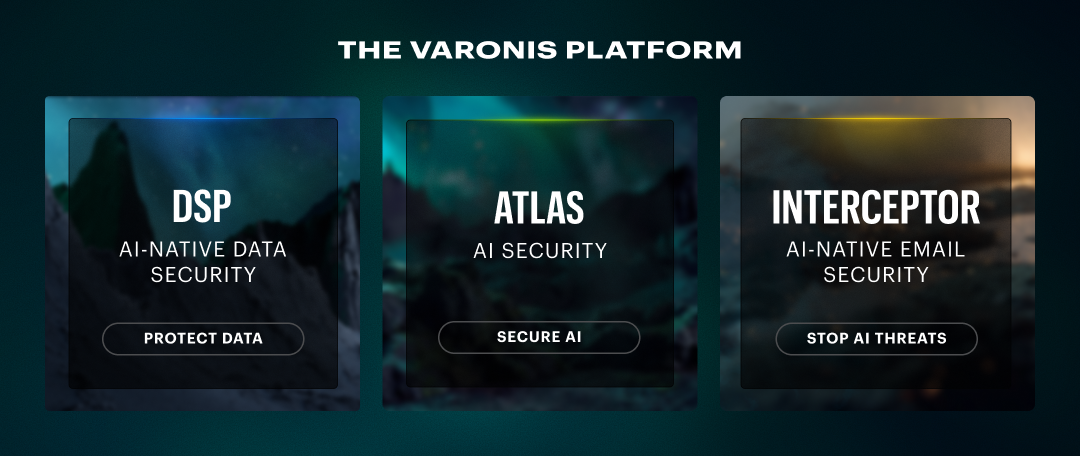
Varonis goes beyond visibility, providing the capabilities needed to automate outcomes and reduce risk, enforce policies, and stop threats, including:
- Data Security Posture Management (DSPM) provides continuous visibility into where sensitive data lives, who can access it, and how it’s being used. You can’t protect what you can’t see.
- Database Activity Monitoring (DAM) detects threats and policy violations across databases with an agentless, fast-deploying solution. Your most valuable data needs dedicated monitoring.
- Data Access Governance (DAG) maps and enforces least-privilege permissions at scale. Overprivileged access is one of the most common and exploitable security gaps.
- Data Loss Prevention (DLP) prevents sensitive data from leaving through unauthorized channels. Visibility only matters if you can act on it and stop exfiltration in real time.
- Data Detection and Response (DDR) uses behavioral baselines to detect ransomware, insider threats, and exfiltration in real time. Every breach raises one question: who touched the data?
AI Security
- AI Security Posture Management (AI SPM) discovers and assesses AI agents, copilots,and models for misconfigurations that could expose sensitive data. You can't secure AIyou can't see.
- AI Runtime Guardrails inspects every prompt, response, and agent action in real time through an AI gateway, blocking sensitive data exposure before it happens.
- AI Governance automates audit reporting and compliance evidence for AI-specific regulations and frameworks. New mandates become configuration changes, not new projects.
Email security
- Social Engineering Defense uses multi-layered AI to stop phishing, BEC, and impersonation attacks before they reach the inbox. AI-generated threats demand AI-powered protection.
The unified platform provides deeper visibility across the entire data estate with context that makes findings actionable. and makes every capability stronger. Sensitivity, access, and behavior are correlated in real time within a single platform rather than stitched together after the fact.
Datasecurity not only classifies and protects sensitive data, but also considers AI agent activity and email-borne threats. AI security not only evaluates agent guardrails, but also knows what data is sensitive, who should access it, and what normal behavior looks like. Email security not only identifies phishing messages, but also connects each phishing attempt to the recipient's blast radius. That context is only possible when data security, AI security, and email security are built together, not bolted on.
Unlike standalone solutions, the Varonis platform performs automated remediations to reduce risk, enforce policies, and stop active threats without relying on the interoperability of disparate tools. The result is fewer tools to manage, improved outcomes, and a lower total cost of ownership.
Varonis’ unified platform approach has delivered proven outcomes for thousands of customers around the world and earned accolades, including being named a Leader and Customer Favorite in The Forrester Wave™: Data Security Platforms, Q1 2025, with the highest scores for current offering, strategy, and customer satisfaction, and a Gartner® Peer Insights™ Customers' Choice for DSPM for two consecutive years with a 99% recommendation rate.
A platform approach stops data breaches
Modern attacks span multiple systems. Standalone tools provide siloed views of risk, create gaps, and make it difficult to detect attacks that involve lateral movement or the supply chain. A unified platform protects data across the entire data estate with the context needed to detect and neutralize threats.
Let’s look at an example.
Stopping the Salesloft Drift Breach
In early 2025, a threat actor known as UNC6395 compromised Salesloft’s GitHub repos and stole the OAuth tokens. Those tokens allowed Drift, a widely used chatbot owned by Salesloft, to connect to customers’ Azure, Salesforce, Google Workspace, and other integrated platforms.
Between August 8th and 18th, UNC6395 used those tokens to impersonate the trusted Drift application, bypass MFA, and systematically exfiltrate data from more than 700 organizations. The majority of affected organizations only learned of the breach when Salesforce and Salesloft notified them more than two weeks later.
Varonis customers were the exception.
Varonis’ end-to-end approach stopped this breach before any damage could happen. Here’s how it played out for one organization:
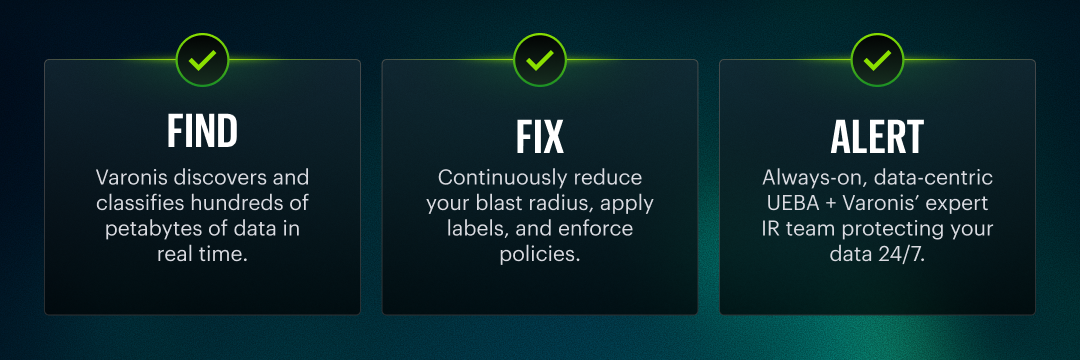
- Step 1: Cross-platform detection. Varonis flagged Drift activity in Azure as abnormal. Its OAuth token refreshes originated from unusual IP addresses and API call volumes exceeded Drift’s established baseline. Varonis issued an alert and began checking Drift activity across other connected systems.
- Step 2: Salesforce telemetry confirms the threat. Salesforce Shield Event Monitoring provided detailed logs that allowed Varonis to identify abnormal Drift-connected app activity in Salesforce, including logins from suspicious IPs and unusual API queries.
- Step 3: Varonis MDDR responds. Varonis correlated the Azure and Salesforce signals, and its Managed Data Detection and Response (MDDR) team engaged the company’s security operations team to immediately act and prevent the breach.
For most companies, this attack was invisible. OAuth abuse looks like normal API traffic, and the attackers deleted query jobs to cover their tracks. Without a data security platform connecting unusual activity across Azure, Salesforce, and Drift, this breach is nearly impossible to catch.
And this is just one example. Consider some common attack scenarios that can only be prevented with a platform approach:
Phishing → Credential compromise → Data exfiltration
A finance employee clicks a convincing phishing link, and the attacker captures their credentials. The attacker accesses SharePoint and begins downloading sensitive financial documents.
- Fragmented data security stack: The email gateway flags the phishing attempt but has no visibility into file activity. The DLP tool sees downloads but can’t tie them to a compromised identity.
- Varonis: Correlates the compromised identity with abnormal file access patterns in SharePoint, detects bulk downloads that deviate from the user’s baseline, and triggers an alert before sensitive data leaves the environment.
AI agent exposes sensitive data
An employee asks the company’s AI assistant for average salary data. The agent pulls from multiple repositories and surfaces data the employee should not have access to, including individual salaries, bonuses, and stock compensation figures.
- Fragmented data security stack: The AI tool has no awareness of data sensitivity or access policies. No alerts are triggered because the query looks like normal usage from an authorized user.
- Varonis: Enforces least-privilege access on the underlying data so the AI agent can only retrieve what the user is authorized to see, preventing sensitive data from being surfaced in the first place.
Database exfiltration via compromised service account
A service account runs abnormal read queries against sensitive customer tables during off-hours. An egress event follows shortly after.
- Fragmented data security stack: The database monitoring tool logs the queries but lacks user behavior context. The network tool sees the egress but can’t connect it to the database activity. Neither tool escalates.
- Varonis: Detects the off-hours query spike against sensitive tables, correlates it with the subsequent egress event, flags the service account compromise as a single incident, and disables the service account while the team investigates.
Ransomware spreads through overprivileged access
An employee opens a malicious attachment that deploys ransomware. The malware begins encrypting files across every share the user can access, which due to excessive permissions spans far beyond their role.
- Fragmented stack: The endpoint tool detects encryption behavior on the local machine but has no visibility into network file shares. The storage team sees mass file modifications but can’t identify the source. Response is slow and the blast radius is massive.
- Varonis: Detects the anomalous encryption pattern across file shares in real time, automatically disables the compromised account. Blast radius is minimum because least-privilege policies have already cut off all unnecessary access.
Platform approach lowers TCO
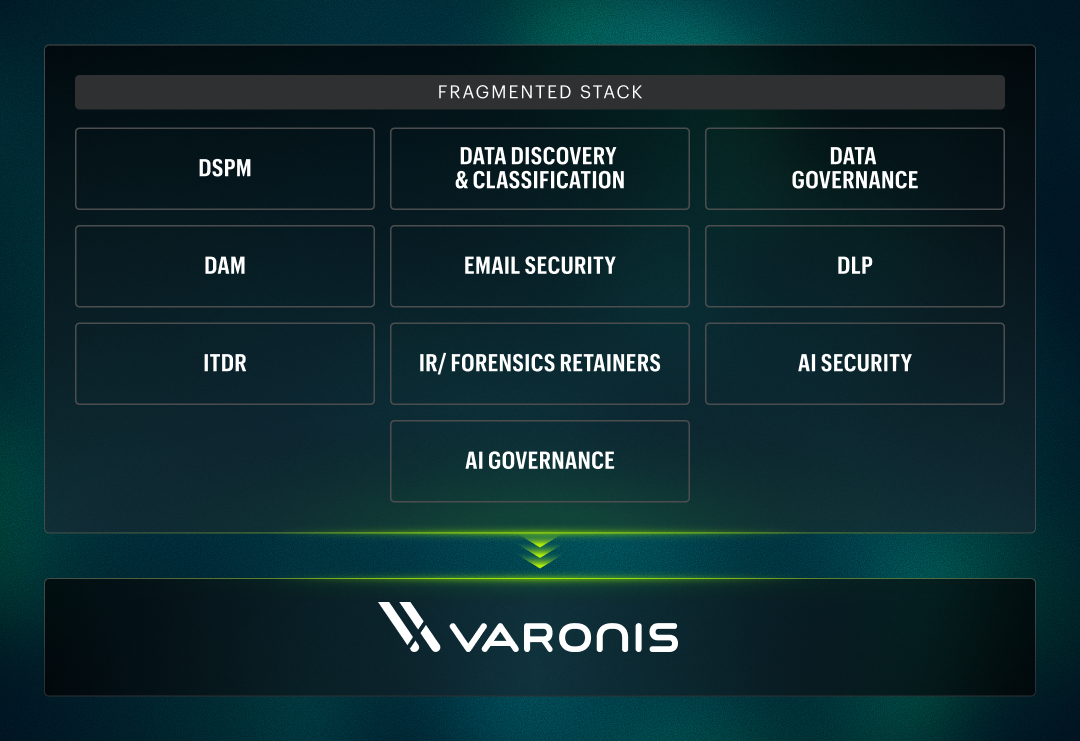
The Varonis Data Security Platform drives ROI across three dimensions: cost consolidation, operational efficiency, and measurable risk reduction. Because data security, AI security, and email security sharea single platform, organizations not only consolidate their tools but the context those tools need to beeffective.
Consolidation and TCO: the hard savings
Organizations can sunset separate licenses for numerous standalone security products that often incur additional costs in specialized resources and support services, including:
- Data Security Posture Management (DSPM) for identifying and reducing exposure across cloud and on-prem data stores
- Data classification for automated discovery and labeling of sensitive or regulated content and data
- Data governance for policy enforcement for data access, retention, and lifecycle management
- Standalone Database Activity Monitoring (DAM) for tracking and auditing database queries and transactions
- Email security for threat detection, DLP, and policy controls for inbound and outbound email
- Identity Threat Detection and Response (ITDR) for spotting compromised accounts and privilege escalation
- IR/forensics retainers for incident response and forensic investigation services engaged on contractor DSPM, data classification, data governance, standalone DAM, email security, AI governance, ITDR, and IR/forensics retainers.
- AI SPM for discovering and assessing AI agents, copilots, and models for misconfigurations and data exposure
- AI Runtime Guardrails for inspecting prompts, responses, and agent actions to block sensitive data exposure
- AI governance for oversight of AI model access, training-data exposure, and prompt-level risk
Typically, customers replace between five and eight licenses with one Varonis platform license, resulting in lower TCO from:
- License rationalization: Consolidating point solutions into one platform eliminates redundant license fees, overlapping coverage, and duplicative support contracts.
- Smaller infrastructure footprint: A shared telemetry layer using API and audit-log ingestion replaces duplicative sensors, scanners, collectors, and agents.
- Zero integration debt: No more professional services or internal engineering hours spent writing and maintaining brittle glue code between incompatible tools.
- Reduced training burden: Analysts learn one console instead of 5-8 disparate interfaces with separate workflows, query languages, and escalation paths.
Operational efficiency: the time dividend
With Varonis, customers reclaim thousands of hours that SOC analysts currently spend filing tickets, chasing false positives, and manually correlating alerts.
- Reduced MTTR: Varonis presents a correlated incident with identity, sensitivity, behavior, and blast radius rather than isolated alerts. Analysts get the complete picture instead of assembling it manually across consoles.
- Automated remediation: What previously required a cross-departmental meeting, and a help desk ticket now gets handled via automated policy or a single click, freeing security teams for strategic work.
- Analyst time reclaimed: Hours spent on manual correlation, ticket management, and cross-console investigation are redirected to proactive risk reduction.
Risk reduction and compliance: quantifiable security outcomes
The Varonis Data Security Platform allows security leaders to report on metrics that measure risk, not just activity.
- Measurable blast radius reduction: Track the drop in sensitive files accessible to "everyone," over-privileged accounts right-sized, and stale permissions removed. These metrics map to actual risk, not busywork.
- Audit readiness: A single system of record for classification decisions, access changes, behavioral alerts, and remediation actions. When auditors ask for proof, the answer is a generated report, not a cross-functional project.
- Regulatory defensibility: The platform maps controls to regulatory requirements (GDPR, DORA, CCPA, HIPAA, SOX) and continuously generates evidence. New regulations become configuration changes, not new initiatives.
How the Varonis Data Security Platform works
Varonis provides a much greater context for critical decision-making and automated outcomes compared to a stitched-together stack.
When discovery, access, and behavior live in separate tools, analysts become the integration layer. They switch between consoles, export CSVs, normalize timestamps, and try to piece together a coherent story from fragments. By the time they connect the dots, incidents escalate.
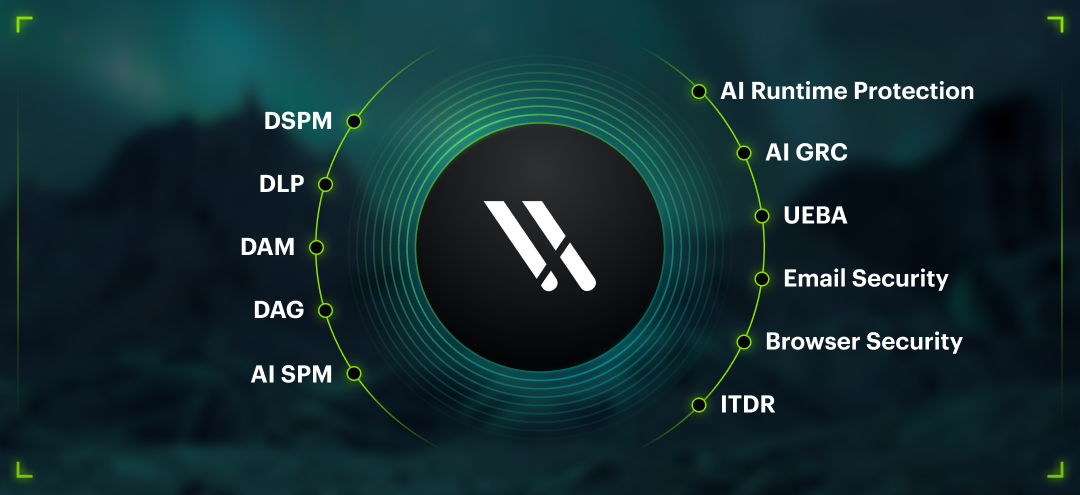
Varonis eliminates manual correlation by combining connectivity, context, and action.
Connectivity: One telemetry pipeline across the entire data estate
Varonis connects to your data wherever it lives: SaaS applications, cloud infrastructure, databases, on-premises file shares, email, browsers, identity providers, network devices, and endpoints as well as AI agents and models that interact with your data. Every identity, whether human, service account, application, or AI agent, is resolved across Active Directory, Entra ID, Okta, and SaaS platforms into a single graph. This unified connectivity means cross-system patterns that would be invisible to siloed tools become obvious. Because AI agents share the same telemetry pipeline and identity graph as human users and service accounts, AI security is native to the platform rather than a bolt-on.
Context: The intelligence that makes signals actionable
Raw telemetry isn’t enough. Varonis enriches every event with the context needed to make real-time decisions: data sensitivity and topic, attack paths, blast radius, user intent, toxic access combinations, and forensic detail. Every signal is weighted against effective permissions and behavioral baselines, so when something happens, Varonis already knows what data is at risk, who is involved, and how far the damage could spread. This transforms detection:
- A stale admin account reactivates after months of inactivity. Varonis knows it still has access to 50,000 sensitive files, the reactivation came from an unfamiliar device, and the account was flagged for deprovisioning.
- A new OAuth app requests broad permissions across Salesforce and SharePoint. Varonis maps exactly which sensitive data stores it could reach and scores the risk before a single query executes.
- An AI copilot is deployed with access to a shared drive containing M&A documents. Varonis identifies the sensitive content, flags the overly broad permissions granted to the copilot, and calculates the exposure before any user prompts it.
- A departing employee's download volume spikes during their final week. Varonis correlates the activity with HR-flagged offboarding status, identifies the sensitive files being accessed, and scores the exfiltration risk.
Action: Automated enforcement, not just alerts
Context without action is just a dashboard. Varonis closes the loop with automated responses calibrated to the severity and context of each event.
- When a stale admin account reactivates and begins accessing sensitive files, Varonis disables the account and creates an incident with full scope of what was touched.
- When an OAuth app with broad permissions starts querying data outside its stated scope, Varonis revokes the token and alerts the app owner.
- When an AI copilot surfaces M&A documents to an unauthorized user, Varonis blocks the response, scopes down the copilot's permissions, and notifies the data owner.
- When a departing employee's download volume spikes in their final days, Varonis restricts access to sensitive repositories and notifies their manager.
Every automated action includes dependency checks to avoid breaking production workflows and one-click rollback if something needs to be reversed. Athena AI streamlines investigations further, letting analysts query the full picture using natural language.
Complementing your existing security ecosystem
Varonis works with the native security capabilities built into the platforms you already run, including Microsoft Purview and E5 Security, AWS Security Hub, and Salesforce Shield.
Where these tools provide foundational controls within their own ecosystems, Varonis extends classification, access governance, and threat detection across your entire data estate and pairs static labels and permissions with real-time behavioral context.
Varonis also integrates directly with your broader security infrastructure:
- SIEM. Surface Varonis’ data-centric, context-rich alerts in Microsoft Sentinel, Splunk, and IBM QRadar for faster triage and investigation.
- SOAR. Incorporate Varonis alerts into automated playbooks in Cortex XSOAR and Splunk SOAR to accelerate threat response.
- EDR. Correlate endpoint telemetry from CrowdStrike, SentinelOne, and Microsoft Defender for Endpoint with data-layer activity for complete attack visibility.
- CSPM. Unify cloud misconfiguration findings from AWS Security Hub, Azure Policy, and Wiz with data risk context.
- Ticketing. Route alerts and remediation recommendations directly into ServiceNow and JIRA workflows.
- PAM. Manage Varonis credentials securely through CyberArk to meet compliance requirements and minimize risk.
Rather than adding another tool to monitor, Varonis becomes the connective tissue that makes your entire security ecosystem smarter. Every tool in your stack, from SIEM to EDR to SOAR, gains the data context needed to distinguish real threats from false positives and trace attacks from initial compromise through data exfiltration.
Security leaders are choosing the platform approach
The shift away from fragmented stacks to integrated data security platforms is accelerating and AI is compressing the timeline.
Gartner declared in 2024 that we've entered "the next phase of security platform consolidation." The urgency is growing: Gartner predicts that by 2026, 75% of organizations running GenAI initiatives will reprioritize data security spending toward unstructured data, and that through 2030, a third of all IT work will go toward remediating "AI data debt" caused by poorly secured and ungoverned data.
Security leaders see the shortcomings of fragmented security stacks where classification, access governance, threat detection, and AI security live in separate products:
- Classification tools label data but have no visibility into who can access it or whether that access is normal.
- Access governance tools manage permissions but can’t tell whether the data behind them is sensitive or high-risk.
- Threat detection tools fire alerts but lack the data context to separate real attacks from routine activity.
- AI security tools evaluate models, prompts, and agent behavior but have no insight into the underlying data, its sensitivity, who can access it, or whether exposure has already occurred.
The result is blind spots, false positives, and incidents that are only understood after they've done their damage. A fragmented security stack isn't just expensive, it's a liability. As organizations rush to deploy AI, bolting on yet another siloed tool only widens the gaps. Data security and AI security are inseparable: you can't protect AI without understanding the data it touches, and you can't protect data without accounting for the AI that accesses it. That's the platform advantage.
To see where your organization stands, request a complimentary Data Risk Assessment.