Key takeaways
- AI-SPM continuously assesses AI applications, models, agents, and the data and infrastructure behind them for combinations of risk, then helps teams fix them.
- It complements DSPM and CSPM by covering AI-specific exposure paths such as retrieval pipelines, model artifacts, and agent toolchains.
- Frameworks such as the NIST AI RMF, ISO/IEC 42001, and the EU AI Act expect ongoing, evidence-backed AI risk management that AI-SPM helps provide.
Do you know which of your AI systems is most likely to cause your next security incident?
Enterprise AI use is now the norm, but security processes have been slower to catch up. The World Economic Forum's Global Cybersecurity Outlook 2026 found that the share of organizations assessing the security of their AI tools nearly doubled, from 37% in 2025 to 64% in 2026. That still leaves roughly one-third with no process to validate AI security before deployment.
Most security teams now accept a basic truth: You can't protect what you can't see. The Varonis 2025 State of Data Security Report found that 98% of organizations have unverified apps, including shadow AI. That realization has driven a wave of investment to discover where AI exists, how it's being used, and which systems and components enable it. But visibility alone doesn't reduce risk. Native tools from AI and cloud platforms add visibility, but many assess only one risk vector: misconfigurations.
That's where dedicated AI Security Posture Management (AI-SPM) comes in. AI-SPM is the discipline that turns AI visibility into action. It continuously assesses AI systems for multiple conditions that create security, compliance, and operational risk, and helps teams fix those issues before they turn into incidents.
This guide covers how AI-SPM differs from DSPM and CSPM, what it covers, the risks it catches, why regulators care, and how to put it into practice.
What does AI-SPM cover?
In reality, AI systems are composed of multiple components, so effective AI-SPM must span four layers:
- AI applications: Chatbots, copilots, agents, and embedded applications
- Models and inference endpoints: Commercial, open-source, and fine-tuned models, and hosted APIs
- Agentic components and tools: Agents and MCP servers, the tools they can invoke, and orchestration frameworks
- Data, code, and supporting infrastructure: Datasets, notebooks, pipelines, storage, credentials, and cloud services
If a component influences AI behavior, it contributes to AI risk and falls within the scope of posture management.
AI-SPM: Forecasting risk
To better understand AI-SPM, it's helpful to turn to meteorology. Modern-day weather forecasters can't prevent storms, but they can prevent surprises thanks to a range of instrumentation, including radar, satellites, atmospheric models, and early-warning systems. Meteorologists track conditions long before a storm forms, model how those conditions evolve, and issue watches and warnings while there's still time to act.
AI security works the same way. AI inventory and visibility are the radar and satellites, and they answer foundational questions, such as What AI systems exist? and Where does data flow in and out of them?
AI-SPM builds on that foundation by asking a harder question: Given what we've discovered, what is most likely to go wrong next? Seeing a storm on radar doesn't tell you whether it will strengthen, where it will land, or how severe the impact will be. For that, you need forecasting, turning raw visibility into risk signals, and risk signals into prioritized action.
Risk signals can include:
- Known vulnerabilities in AI code and models
- Misconfigurations in AI-supporting cloud infrastructure or endpoints
- Sensitive data embedded in AI development artifacts
- Potentially poisoned tools
- Misaligned behavior from MCP servers
These risks aren't hypothetical. Varonis Threat Labs disclosed the SearchLeak vulnerability in Microsoft 365 Copilot Enterprise, a chain that let an attacker steal sensitive data with a single click before Microsoft patched it. Many AI risk signals are the equivalent of atmospheric instability: conditions that look benign in isolation but dangerous in combination.
The risks AI-SPM is designed to catch
AI-SPM should flag individual vulnerabilities, but its real value is showing how isolated issues combine into meaningful risk. A few common combinations:
- Outdated dependencies paired with permissive cloud identities, which can expand an attacker's path to exploitation.
- Sensitive data embedded in notebooks that feed retrieval pipelines, which can expose information in ways teams may not recognize.
- Agents with access to tools beyond their intended purpose, which can introduce misuse or unintended actions.
On their own, these issues may appear low severity. Together, they create the conditions for high-impact failures.
Agentic AI risk
Agents deserve particular attention because they act on data. An agent can read, write, and call tools with limited human oversight, and it often inherits the permissions of the user or service account behind it. The OWASP Gen AI Security Project lists this risk as excessive agency, caused by excessive functionality, excessive permissions, or excessive autonomy.
Posture checks for agents need to cover what an agent can do, not only what it can see. That's why guardrails such as agent intent-based access control compare an agent's task with the tools and data it reaches for.
The data underneath matters just as much. Varonis' 2025 State of Data Security Report, based on 1,000 real-world IT environments, found that 99% of organizations have exposed sensitive data that can easily be surfaced by AI.
That is why AI-SPM surfaces findings across categories, such as CVEs, misconfigurations, data exposure, model integrity issues, endpoint vulnerabilities, and agentic threats, then connects those findings back to the systems they affect. The goal is to help teams understand which combinations of risk matter most and where action is needed first.
How AI‑SPM differs from DSPM and CSPM
AI-SPM is sometimes applied as a label to existing posture management tools, but the distinction matters.
-
Data Security Posture Management (DSPM): Focuses on data, including where sensitive data lives, how it's classified, and who can access it. AI-SPM overlaps with DSPM when sensitive data appears inside AI assets.
-
Cloud Security Posture Management (CSPM): Focuses on cloud infrastructure, such as identity, networking, storage access, and baseline configuration. AI-SPM includes those checks, but extends posture management into areas CSPM wasn't designed for, such as AI code dependencies, model artifacts, inference endpoints, and agent toolchains.
The approaches work best together: DSPM secures the data, CSPM secures the cloud foundation, and AI-SPM secures the AI systems that reach both.
Here's how the three approaches compare:
Why AI‑SPM matters to governance and regulation
AI-SPM is also becoming a governance expectation. Standards and regulations increasingly ask organizations to show, not just state, that AI risk is under control.
-
Frameworks such as ISO/IEC 42001 emphasize lifecycle-based AI risk management. That assumes organizations can continuously identify and mitigate technical risk, not just write policies about it.
-
The NIST AI Risk Management Framework organizes AI risk work into four functions: Govern, Map, Measure, and Manage. According to NIST, Measure uses quantitative, qualitative, or mixed-method tools to "analyze, assess, benchmark, and monitor AI risk," and Manage allocates resources to mapped and measured risks "on a regular basis." Ongoing assessment of vulnerabilities, misconfigurations, and unsafe behavior supplies the posture data those functions rely on.
-
Under the EU AI Act, posture requirements carry legal weight. Article 15 requires high-risk AI systems to achieve "an appropriate level of accuracy, robustness, and cybersecurity" throughout their lifecycle, and Article 12 requires them to support automatic logging. AI-SPM helps produce evidence that those controls work in practice, well ahead of the Act's deadlines.
How is AI-SPM different from AI governance?
AI governance sets the rules: who owns AI risk, which uses are acceptable, and which policies apply. AI-SPM checks whether AI systems follow those rules in practice. It continuously assesses configurations, access, data exposure, and agent behavior, then produces the evidence governance teams need.
Most organizations need both. Governance without posture data is policy on paper, and posture findings without governance lack clear owners and risk thresholds.
How to put AI-SPM into practice
AI-SPM works best as a continuous program, not a one-time scan:
- Start with a complete AI inventory. Discover sanctioned and unsanctioned AI across cloud accounts, code repositories, AI platforms, and SaaS apps. AI-SPM is one part of the full AI security lifecycle, alongside runtime guardrails, compliance, and third-party risk.
- Connect every AI asset to the data it can reach. Knowing an agent can reach a SharePoint site matters less than knowing it can reach millions of customer records. Posture findings without data context can't show real impact.
- Prioritize combinations, not single findings. Rank risk by how issues across the four layers compound, so teams fix the paths that matter first.
- Remediate, don't just report. Assign owners and fix issues from the platform or with guided instructions in the affected environment, so findings don't become a never-ending to-do list.
- Assess continuously and keep the evidence. AI systems change constantly. Periodic review is becoming the norm: the World Economic Forum found that 40% of organizations review their AI tools periodically before deployment, while 24% do only a one-time assessment. Keep posture findings and remediation records as audit evidence for frameworks such as ISO/IEC 42001 and the EU AI Act.
How Varonis Atlas supports AI-SPM
Varonis Atlas turns raw visibility into risk signals, and risk signals into prioritized action. Security teams can run remediation from the platform or follow instructions and guidance to make changes within the specific environment impacted.
Because Atlas works with the Varonis Data Security Platform, posture findings carry real data context: which sensitive data an AI system can reach. Varonis was named a Pace Setter in the September 2026 Gartner® Emerging Market Quadrant for AI Application Security.
Varonis Atlas turns raw visibility into risk signals, and risk signals into prioritized action.
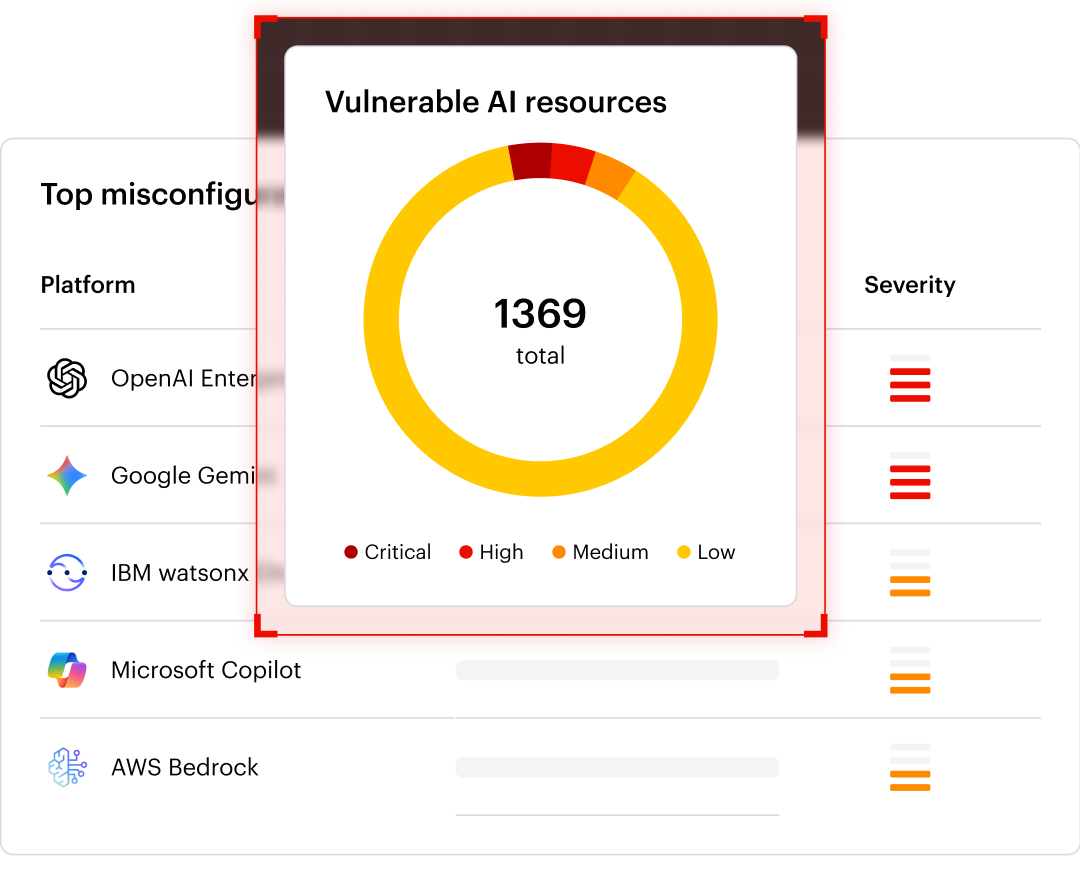
Varonis Atlas turns raw visibility into risk signals, and risk signals into prioritized action.
Take action on AI-SPM findings rather than creating a never-ending list of to-dos.
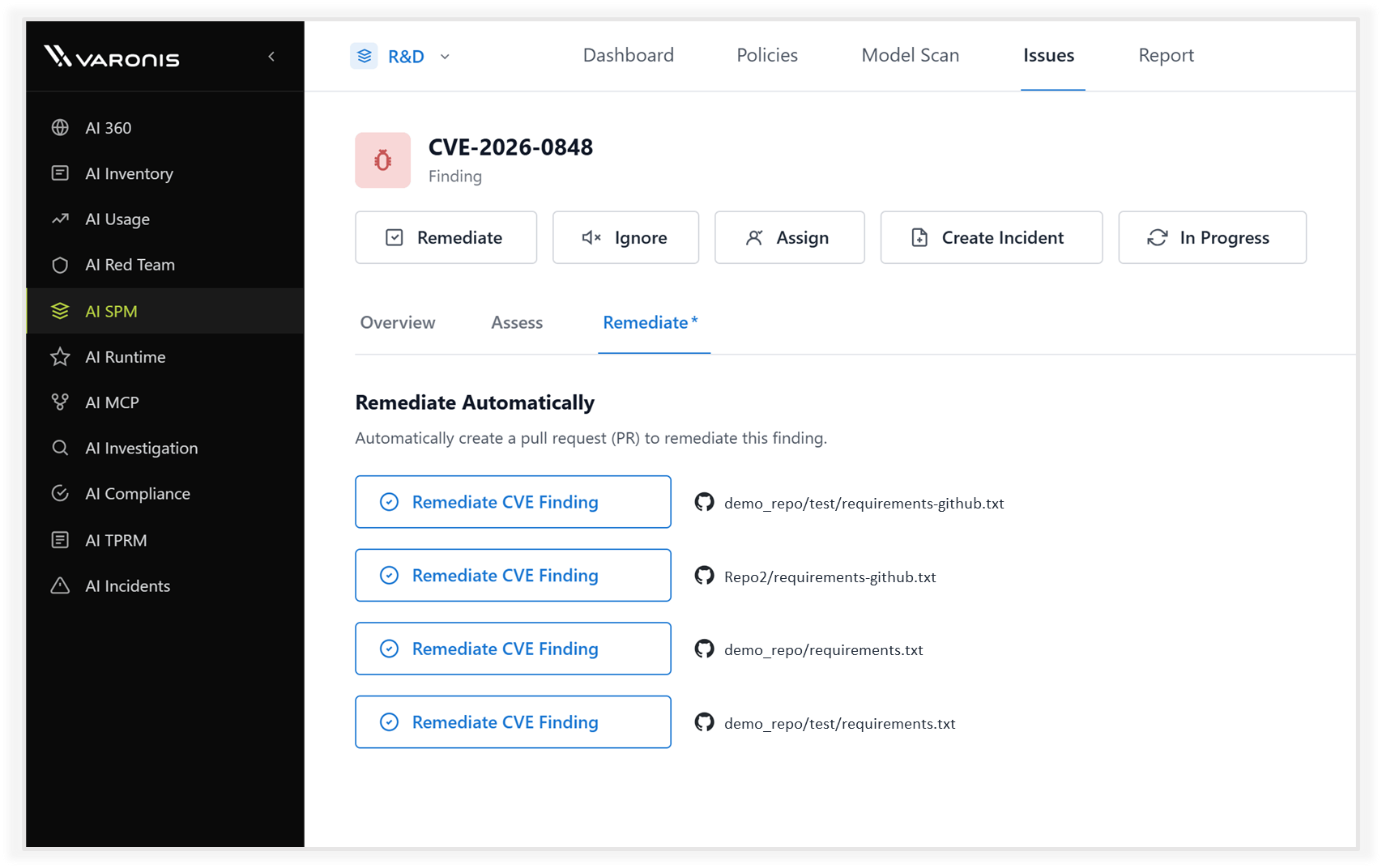
Take action on AI-SPM findings rather than creating a never-ending list of to-dos.
Varonis Atlas gives security teams the context to know the total risk profile of every finding and how to remediate.
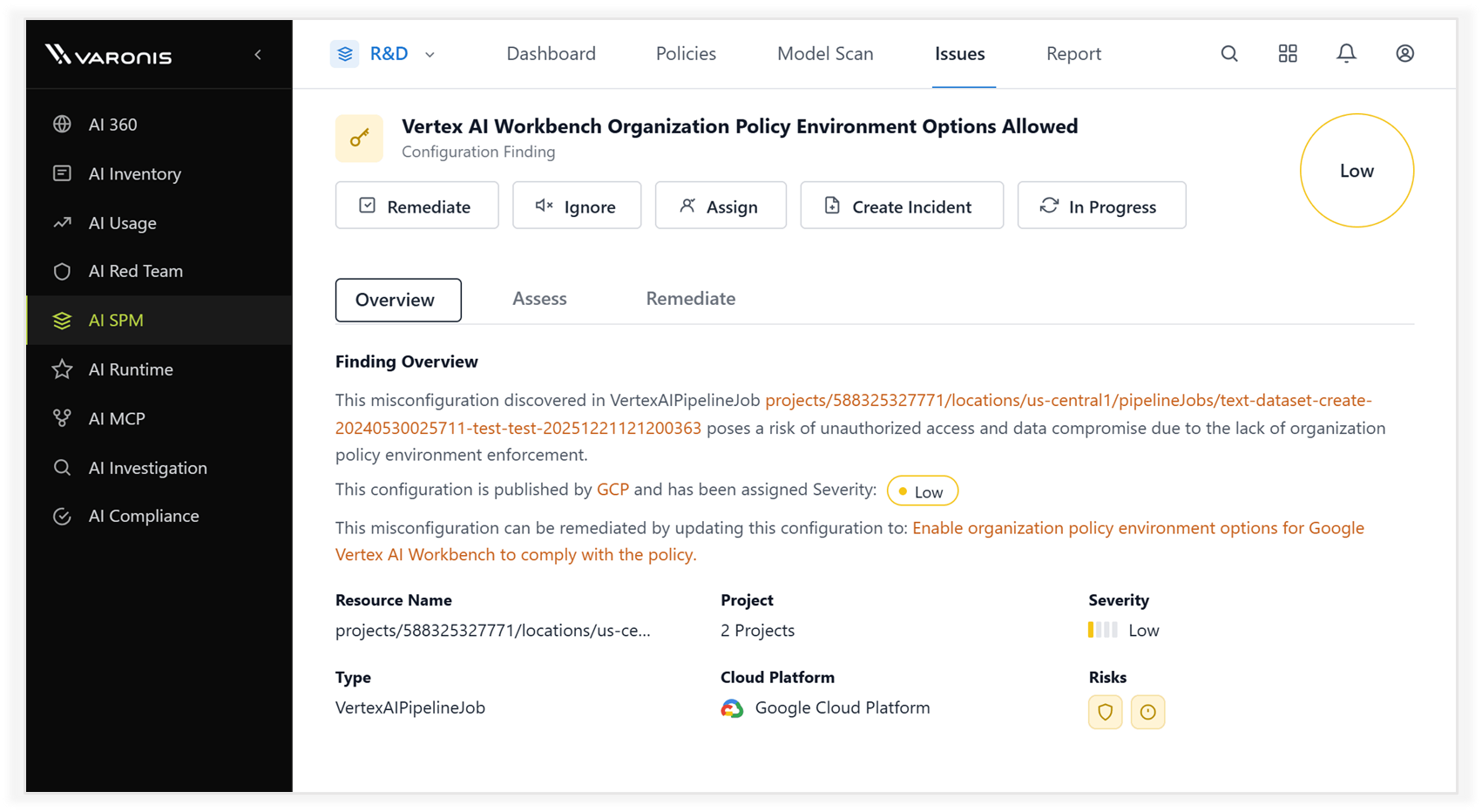
Varonis Atlas gives security teams the context to know the total risk profile of every finding and how to remediate.
From visibility to action: why AI-SPM matters now
Meteorologists don't issue warnings for every cloud they see. They issue them when a meaningful set of conditions crosses a threshold and signals a credible chance of impact.
AI-SPM brings that same discipline to AI security. It helps teams separate background noise from the combinations of conditions that warrant attention, while there's still time to respond. As AI systems become more autonomous, more interconnected, and more regulated, AI-SPM is a core capability of complete AI security platforms. It's the mechanism that moves AI security from reactive cleanup to proactive risk management.



.png)