The MITRE ATT&CK framework has become foundational to today’s security programs. The framework fills a gap left by compliance checklists and vulnerability scans that don’t reflect how attackers operate in modern environments.
Though often referred to as a compliance standard or regulation, MITRE ATT&CK is better understood as a knowledge framework that helps organizations analyze, detect, and respond to real world adversary activity. This guide breaks down what the MITRE ATT&CK framework is, how organizations align to it in practice, and how Varonis helps organizations operationalize the framework to protect their most critical data.
What is the MITRE ATT&CK Framework?
MITRE ATT&CK (Adversarial Tactics, Techniques, and Common Knowledge) is a globally accessible knowledge base of adversary behavior, maintained by the MITRE Corporation. It documents how attackers plan, execute, and advance cyber intrusions based on real world observations from security incidents, threat intelligence, and research.
Rather than cataloging vulnerabilities or specific malware, ATT&CK focuses on attacker behavior, including what adversaries aim to accomplish and how they execute their attacks once they target an environment. This behavioral approach makes the framework resilient even as tools, exploits, and infrastructure change.
How MITRE ATT&CK is structured
MITRE ATT&CK organizes adversary behavior into a matrix that reflects the lifecycle of an attack:
- Tactics represent the attacker’s objective (the “why”), such as Initial Access, Credential Access, or Exfiltration.
- Techniques describe the methods used to achieve those objectives (the “how”).
- Sub techniques add further granularity by breaking techniques into specific variations.
- Procedures capture real world examples of how techniques have been carried out in actual attacks.
MITRE maintains multiple matrices to reflect different environments, including Enterprise ATT&CK (on premises, cloud, SaaS, and identity environments), Mobile ATT&CK, and Industrial Control Systems (ICS) ATT&CK.
For the Enterprise ATT&CK matrix, MITRE currently defines 14 tactics, each representing a distinct objective attackers pursue as they move through an attack lifecycle. MITRE defines these tactics as:
- Reconnaissance – The adversary is trying to gather information they can use to plan future operations
- Resource Development – The adversary is trying to establish resources they can use to support operations
- Initial Access – The adversary is trying to get into your network
- Execution – The adversary is trying to run malicious code
- Persistence – The adversary is trying to maintain their foothold
- Privilege Escalation – The adversary is trying to gain higher-level permissions
- Defense Evasion – The adversary is trying to avoid being detected
- Credential Access – The adversary is trying to steal account names and passwords
- Discovery – The adversary is trying to figure out your environment
- Lateral Movement – The adversary is trying to move through your environment
- Collection – The adversary is trying to gather data of interest
- Command and Control – The adversary is trying to communicate with compromised systems
- Exfiltration – The adversary is trying to steal data
- Impact – The adversary is trying to manipulate, interrupt, or destroy systems and data
Is MITRE ATT&CK a regulation?
Despite how it’s often described, MITRE ATT&CK is not a regulation, mandate, or compliance standard. There is no certification, audit, or formal requirement to “comply.” Instead, MITRE ATT&CK is a reference framework designed to help organizations understand and defend against real attacker behavior.
MITRE ATT&CK use cases
Organizations align their security programs to the ATT&CK framework by incorporating it into day today operations. Common alignment practices include:
-
Test cyber resiliency: Security teams can use ATT&CK techniques to plan a scenario to test network defenses, enabling red teams to design realistic attach scenarios for penetration testing and validation of network defenses.
-
Plan cybersecurity strategy: Security teams can use ATT&CK to plan their cybersecurity strategy by mapping defenses and monitoring to known attack techniques, ensuring visibility into real world attacker behavior.
-
Reference for Incident Response (IR) teams: ATT&CK helps incident response teams analyze potential threats, align response actions to known attacker techniques, and improve readiness for future incidents.
-
Overall cyber defense assessment: ATT&CK can help organizations to assess their overall cybersecurity posture, identify gaps in coverage, and prioritize improvements based on observed attacker behavior.
How Varonis supports the MITRE ATT&CK framework
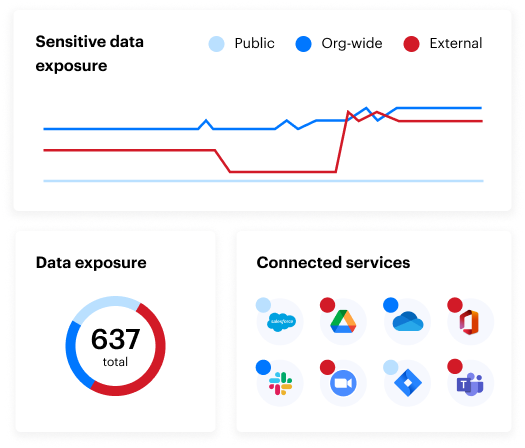
In most cases, data is the ultimate target for attackers. Varonis helps organizations operationalize MITRE ATT&CK by tying attacker behavior directly to data, identity, and activity.
Detects reconnaissance activity targeting identities and data
Varonis aligns to ATT&CK reconnaissance techniques by monitoring directory services, like Active Directory, DNS, email, and data activity across cloud data stores, SaaS applications, and file systems to surface abnormal behavior associated with information gathering. By discovering and classifying sensitive data and identifying privileged accounts, Varonis helps detect early stage attempts to understand the organization, its users, and its most valuable data.
Uses behavior-based analytics to uncover compromised accounts and infrastructure
Varonis builds behavioral baselines for human and non-human users across the entire data estate. It detects anomalies such as geo‑hopping, unusual DNS activity, and access to malicious domains, helping security teams identify compromised accounts and attacker‑controlled infrastructure early.
Monitors identity driven initial access techniques in real time
Varonis maps to MITRE ATT&CK initial access techniques, such as phishing and the use of valid accounts by continuously monitoring email, authentication activity, identity changes, and data access. By correlating identity behavior with sensitive data access, Varonis detects suspicious access patterns even after successful login, while automated remediation enforces least privilege to reduce blast radius and limit attacker impact.
Correlates data activity, events, identity, and email behavior to expose execution behavior
Varonis correlates abnormal data activity, authentication events, identity changes, and email behavior back to specific users and service accounts. By analyzing how identities interact with sensitive data after login, Varonis can identify signs of malicious activity even when attackers use legitimate credentials or built-in system tools, while automated remediation reduces blast radius by enforcing least privilege.
Reduces blast radius by enforcing least privilege
Varonis actively limits attacker success by automatically remediating excessive access and enforcing least privilege. This directly mitigates multiple ATT&CK techniques by restricting lateral movement and preventing unauthorized access to sensitive data.
Identifies multistage attacker behavior
Varonis goes beyond isolated detections by correlating identity, events, and data activity across the entire data estate to determine whether suspicious behavior is a single event or part of a multistage attack mapped to MITRE ATT&CK tactics. By mapping and monitoring attack paths to sensitive data, Varonis helps security teams understand how adversary techniques progress across the environment and prioritize response based on real data exposure risk.
Bringing MITRE ATT&CK to life with datacentric security
MITRE ATT&CK provides a powerful framework for understanding how attackers operate across the full lifecycle of an attack. But its real value comes from how effectively those insights are applied in practice. As modern attacks increasingly rely on compromised identities, legitimate tools, and multistage attack paths, security teams need visibility into how attacker behavior connects to sensitive data.
Varonis helps organizations operationalize MITRE ATT&CK by tying adversary techniques directly to identity activity and data access. By combining continuous monitoring, behavioral analytics, and least privilegeenforcement, Varonis enables earlier detection, clearer attack context, and reduced impact—helping organizations protect what matters most as attacker tactics continue to evolve.