Data Security Posture Management (DSPM) combines data discovery, data access control, and data monitoring, with a focus on securing sensitive data in cloud environments. Vendors, analysts, and practitioners all use the term—often to describe very different things.
So, what is DSPM? In this blog, we’ll cut through the noise and debunk some of the most common DSPM myths, clarifying what it isn’t and how to evaluate it.
Why does DSPM exist?
In a cloud-first world, very little data lives on endpoints. Instead, sensitive data is spread across cloud infrastructure, SaaS applications, and on-prem file systems. Most enterprises rely on dozens of platforms like Microsoft 365, Google Workspace, Salesforce, AWS, Azure, and more—all of which can store critical data.
As data sprawls across these environments, security teams are left asking fundamental questions:
- Where is our sensitive data?
- Who can access it?
- Is it exposed or under active attack?
DSPM helps to answer those questions and reduce risk where data actually lives, not just at the perimeter. DSPM provides visibility into where sensitive data is located, who has access to it, how it's being used, and how the security controls and permissions are configured on the data stores or applications hosting the data.
With that foundation in place, let’s tackle the myths surrounding DSPM.
Myth #1: DSPM is a new concept.
Truth: The concept of DSPM has been around for years.
Discovering sensitive data, understanding access, and monitoring usage are not new security practices. What is new is the scale and complexity of modern data environments, where data is sprawled across complex cloud and multi-cloud environments with numerous SaaS applications and on-prem data stores.
In the past, most organizations didn’t take a data-first approach. Security investments were concentrated on firewalls, endpoints, and gateways—controls attackers must pass through on their way to the real target: the data.
DSPM helps reframe the conversation around that reality. But not all solutions are created equally.
Many DSPM vendors can show you where sensitive data lives. Far fewer can help you reduce exposure, fix risky permissions, and detect threats in real time.
Varonis discovers where sensitive data lives, maps access and permissions, audits who’s accessing the data, and takes steps to remediate it and lock it down. Varonis goes far beyond discovery to reduce exposure and stop threats.
And that gap between discovery and action becomes even more obvious when we look at how narrowly many DSPM tools are applied.
Myth #2 DSPM is all about cloud infrastructure and DevOps.
Truth: DSPM is about data—and data is everywhere.
Much of today’s DSPM conversation starts with cloud infrastructure: object storage, databases, data lakes, and IaaS platforms like AWS, Azure, and GCP. Those environments are important, but they’re only part of the picture.
Some of the most sensitive and frequently accessed data lives in SaaS and collaboration platforms, where users control sharing and permissions. Think Microsoft 365, Google Workspace, Salesforce, and evenemail. These platforms have wide attack surfaces and highly complex permission models.
Data also moves. Users export it, copy it, share it, and upload it elsewhere, which creates risk throughout the data lifecycle. A DSPM strategy that focuses only on IaaS creates dangerous blind spots.
Effective DSPM must span all data domains and data types. However, that doesn’t mean you need coverage for every data store on day one. It might be impossible to find a single DSPM platform that covers all data stores a business uses. Instead, follow the 80/20 rule: prioritize the environments where your most mission critical data lives and ensure you have consistent visibility and controls across them.
Myth #3: DSPM is all about discovery.
Truth: Discovery is just the starting point.
Data discovery and classification are foundational to DSPM—but they’re not the end goal. Discovery alone doesn’t tell you whether sensitive data is actually exposed, who can effectively access it, or whether it’s being misused or attacked.
Many DSPM-only tools lack the context needed to identify whether sensitive data is at risk, resulting in non-actionable information. These products measure data security posture by counting sensitive data findings and do not consider exposure from misconfigurations, over-permissive access, stale identities, or active threats. Without this context, DSPM tools are noisy, leading backlogs of ignored alerts and fatigue.
True DSPM requires complete, contextual, and current data classification:
- Complete: Scans all relevant data—not just samples or predictions. Sampling may work for some databases, but it breaks down in massive file stores and object storage.
- Contextual: Classification must be tied to identities, permissions, and activity. Most data breaches—86%—start with stolen credentials. Without understanding who can access sensitive data and how that access is used, classification results are incomplete.
- Current: Data changes constantly. DSPM must keep pace, updating classifications as data is created or modified—not relying on stale, periodic snapshots.
Discovery enables risk reduction—but only when paired with context and action.
Myth #4: Coverage is king.
Truth: Having deep visibility helps reduce risks.
Many vendors claim broad DSPM coverage simply because they can connect to a platform, but “coverage” is about depth as much as it is breadth.
To truly cover a data platform, a DSPM solution must go beyond labeling files or objects as sensitive. It should answer questions like:
- Is our data being used? By whom? Are there any abnormal access patterns that could indicate compromise?
- Is our sensitive data labeled correctly so that our downstream DLP controls work?
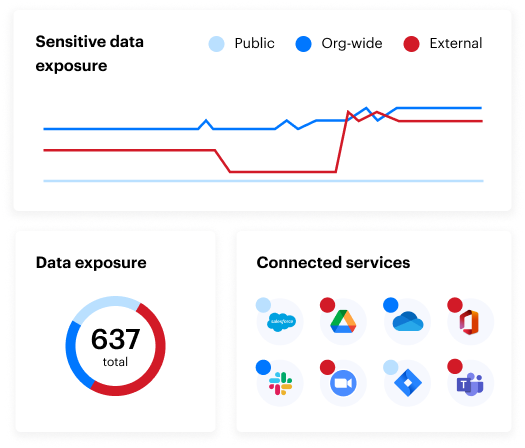
- Is sensitive data exposed publicly? To all employees? To people who don’t require access?
- What is the likelihood that a compromised user could exfiltrate sensitive data?
- What data is stale and can be archived or deleted?
There's a balance to be had between having visibility in a lot of different areas and having deep visibility. Broad but shallow visibility doesn’t reduce risk. Deep visibility, paired with action does.
Myth #5: Workflows equal fixing problems.
Truth: Manual workflows don’t scale, and they don’t stop data breaches.
Opening and closing tickets doesn’t mean risk has been reduced. Manual workflows are slow, error prone, and difficult to scale as data volumes grow, and collaboration accelerates across SaaS, cloud, and hybrid environments.
Effective DSPM must be able to monitor data access, alert you to abnormal behavior, and stop threats in real time. DSPM vendors should have an incident response function, and be capable of continuously removing excessive access, fixing misconfigurations, and responding to abnormal data activity as it happens.
Without automation and real-time response, workflows create the illusion of progress while risk remains unchanged. True DSPM replaces manual effort with continuous protection.
Varonis’ approach to DSPM
At Varonis, we’ve always focused on securing data where it lives.
Our Data Security Platform continuously discovers and classifies sensitive data, maps identities and permissions, automatically removes exposure and risk, and detects threats in real time across SaaS, cloud, and hybrid environments.
Rather than passive findings, Varonis delivers outcomes:
- Reduced blast radius
- Automated remediation & least privilege enforcement
- Proactive threat detection and response
- A greatly reduced blast radius
In today’s threat landscape, visibility alone isn’t enough.
Ready to take action? Our free Data Risk Assessment takes minutes to set up and delivers immediate value. In less than 24 hours, you’ll have a risk-based view of the data that matters most and a clear path to automated data security.