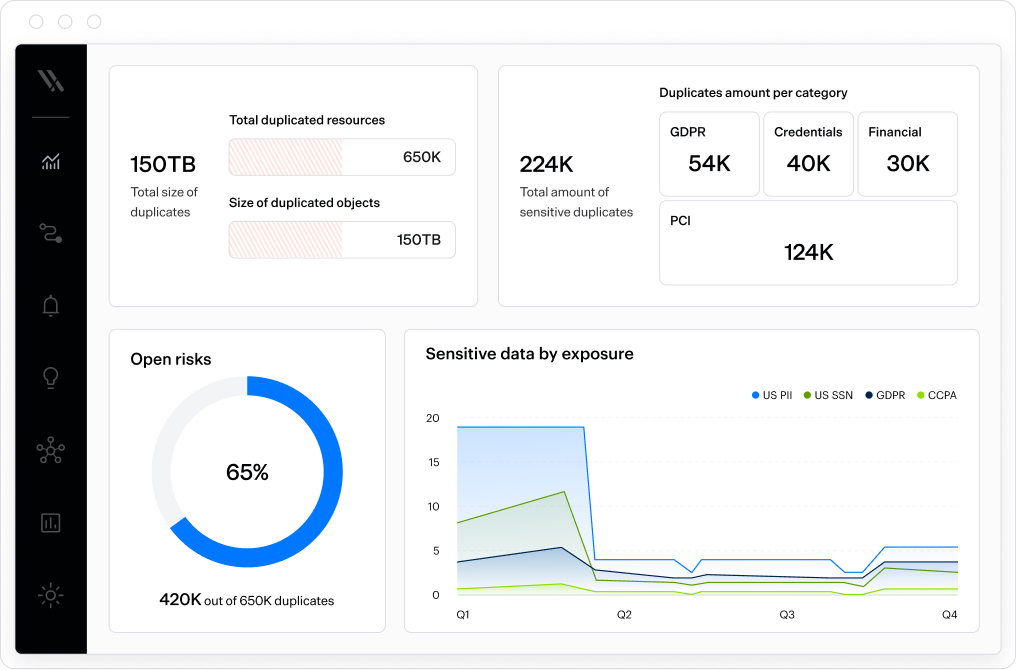
Varonis Data Lifecycle Management (DLM) automatically identifies, prioritizes, and quarantines redundant, obsolete, and trivial (ROT) data across connected data sources. Powered by the Varonis Data Security Platform, DLM combines data classification, permissions mapping, and activity analysis to identify stale, duplicate, overexposed, and expired data. By reducing the volume of unnecessary data stored across the enterprise, DLM helps lower storage and backup costs, minimize security and compliance risk, and maintain cleaner data for AI-driven workflows and analytics.
Learn more about DLM here.
What's new
Explore our latest product enhancements, release notes, acquisitions, and more.
September 15, 2026
Cut storage costs, improve AI outputs, and reduce risk with Data Lifecycle Management
Platform (Data Security)
Data Lifecycle Management
August 23, 2026
Investigate account activity from a single view
Platform (Data Security)
August 23, 2026
Monitor non-human sign-ins in Entra ID
Platform (Data Security)
Sep 2026
Sep 15, 2026
Sep 15, 2026
Platform (Data Security)
Data Lifecycle Management
Cut storage costs, improve AI outputs, and reduce risk with Data Lifecycle Management
Aug 2026
Aug 23, 2026
Aug 23, 2026
Platform (Data Security)
Manage dictionaries directly in the Varonis web interface
Create and update dictionaries directly from the Varonis web interface without switching to the Management Console. This streamlines classification management by keeping dictionaries, EDM classifiers, and classification policies in a single workflow.
Aug 23, 2026
Aug 23, 2026
Platform (Data Security)
Filter and analyze SharePoint sites but sensitivity label
Identify, filter, and analyze SharePoint Online sites based on the sensitivity label assigned directly to the site. This provides greater visibility into site-level classification and helps incorporate site labels into security and compliance investigations.
Aug 23, 2026
Aug 23, 2026
Platform (Data Security)
Identify links generated by Data Lifecycle Automation
Add custom prefixes to links generated by Data Lifecycle Automation policies when content is moved. This makes automation-generated links easier to identify, helping simplify link management, auditing, and ongoing administration.
Aug 23, 2026
Aug 23, 2026
Platform (Data Security)
Monitor non-human sign-ins in Entra ID
Monitor and investigate sign-ins performed by service principals and AI agents in Entra ID. Newly available authentication events provide visibility into activity that was previously unavailable, helping improve detection and investigation of identity-based attacks.
Aug 23, 2026
Aug 23, 2026
Platform (Data Security)
Manage Varonis users and roles from the web interface
Create, view, and manage Varonis users and roles directly from the web interface. This consolidates administration activities into a single management experience and removes the need to use the Management Console for user management.
Aug 23, 2026
Aug 23, 2026
Platform (Data Security)
Investigate account activity from a single view
Investigate account activity from a single view
Investigate account behavior directly from the Account Pane using a dedicated Activity tab that combines activity trends and detailed event logs. Interactive filtering and drill-down capabilities help security teams identify spikes in activity and accelerate investigations.
Aug 23, 2026
Aug 23, 2026
Platform (Data Security)
Manage permissions and groups directly from Analytics page
Review access and take action from the same workflow by managing permissions, groups, folder protection, and memberships directly within the Analytics page.
Aug 19, 2026
Aug 19, 2026
Platform (Data Security)
Schedule scan pauses by day and time zone
Configure different scan pause schedules for each day of the week and specify the time zone used for scheduling. This makes it easier to align maintenance windows, business hours, and operational requirements across geographically distributed environments.
Aug 19, 2026
Aug 19, 2026
Platform (Data Security)
Simplify classification policies with Data Classes
Build classification policies using Data Classes instead of selecting individual patterns and dictionaries. By automatically mapping related classification criteria and locale-specific patterns, Data Classes reduce policy complexity, improve maintainability, and help minimize false positives.
Aug 17, 2026
Aug 17, 2026
Platform (Data Security)
Scope classification scans by AWS Organization
Define scan scope rules using AWS Organization IDs to include or exclude entire AWS Organizations without maintaining lists of individual accounts. This simplifies scan scope management, improves scalability for large AWS environments, and makes it easier to organize scanning policies across organizational boundaries.
Aug 16, 2026
Aug 16, 2026
Platform (Data Security)
See how and why Snowflake resources are being shared
See exactly why a Snowflake resource is labeled as Shared Internally or Shared Externally. Varonis displays the originating shares and associated accounts, helping teams investigate exposure paths and understand inherited sharing relationships more quickly.